One Glory, Two Visions: John 12:41 and the Doxa of the Son
Opening
When the earlier articles on John 12:41 and Isaiah 6 were published on this site, the fuller version of the unitarian argument on this verse was not yet in primary circulation. A pending paper had been announced. The longer treatment from the second edition of Jehovah’s Witnesses Defended had been withdrawn from the third edition. A 2007 paper, revised in 2011, restored the argument and further developed it. This article engages that paper directly.1 The response that follows tries to do three things in order. First, it states the unitarian case at its strongest — the form in which its author should be able to recognize it as his own. Second, it concedes everything that case has gotten right; this is not rhetorical politeness but exegetical honesty, because some of those concessions reshape what a careless Trinitarian reading sometimes assumes. Third, it presses the question of what John 12:41 actually claims and shows that the argument does not, in fact, turn on identifying the Isaianic referent. The conclusion is not a retreat from Isaiah 6. It is the recognition that John 12:41 is a Trinitarian text on either of the two referential possibilities, because the doxa John attributes to Jesus is co-possessed, pre-temporal, and Shekinah — and that is true whether the witnessed glory belongs to the throne vision, to the Servant Songs, or to both.
I. The Published Case at Its Strongest
The following reconstructs the published case’s core moves in a logical sequence, making each component visible for engagement. This reconstruction does not claim to reproduce the author’s original outline or the order of presentation in the 2007/2011 paper; it isolates the four independent lines of argument so that each can be assessed on its own terms.
The first is lexical. The Septuagint of Isaiah uses δόξα across a wide semantic range, and that range explicitly includes human physical appearance and form. Isaiah 52:14 LXX speaks of a doxa disfigured before the sons of men. Isaiah 53:2 LXX situates the figure’s appearance as without doxa. The translators of the Septuagint did not reserve doxa for divine throne-glory. They used it for human form. This is documented, and the published case correctly relies on it.
The second move is structural. John 12:23, 12:28, and 12:32 form a coordinated network around the verbs δοξάζω and ὑψόω. John 12:38 then quotes Isaiah 53:1 directly. The LXX of Isaiah 52:13 reads ὑψωθήσεται καὶ δοξασθήσεται — the same two verbs John has been weaving through the chapter. The published case argues that John 12:41 is the conclusion of this chapter-long arc: Isaiah saw the Servant’s glorification through suffering and exaltation, and John 12:41 names what Isaiah saw.
The third move is the strongest single point in the published case, and it lands cleanly. John 12:41 contains two clauses, not one. Isaiah saw his glory, and Isaiah spoke about him. In Isaiah 6, the prophet speaks of the people’s hardening; he does not describe the figure on the throne. In Isaiah 52–53, the figure of the Servant is the explicit subject of extended prophetic description. The clause “spoke about him” locates more naturally in the Servant Songs than in the throne vision. The published case has pressed this point in live debate and has not received a clean answer.
The fourth move is theological. If the throne vision is the referent, then John 12:41 says Isaiah saw the glory of the figure on the throne, and identifies that figure with Jesus. But John 1:18 says no one has ever seen God. Therefore, on the throne-vision referent, the figure Isaiah saw cannot be the Father. The published case offers a positive theological resolution at this point, not merely a defensive one: the figure is the pre-incarnate Son, understood not as ontologically divine in the conciliar sense but as a glorified being in YHWH’s court — a reading the published case develops from traditional Jewish interpretive material as well as its own confessional tradition, and which it takes to preserve strict Jewish monotheism.
These four moves together form a serious case. It is not a careless argument. It has a lexical foundation, a structural argument from the chapter, a clean grammatical observation about the second clause, and a theological resolution of its own. A response that does not first acknowledge its weight will miss what is actually being said.
II. Where the Published Case Is Right
Several concessions must come first, and they are not concessions of rhetoric but of reading.
The Septuagint does use δόξα for human appearance and form throughout Isaiah. This is not contested. The semantic range of doxa in the Greek Isaiah is broader than throne-glory, and any responsible engagement with John 12:41 must reckon with that range. The point is correctly documented.
The lexical resonance between LXX Isaiah 52:13 (ὑψωθήσεται καὶ δοξασθήσεται) and John 12:23 and 12:32 (δοξασθῇ, ὑψωθῶ) is real. It is not coincidence. John knows the LXX of Isaiah 52–53. He is drawing on its verbal world. The published case has identified this correctly.
John 12:38 quotes Isaiah 53:1 directly. Whatever else John 12:41 refers to with ταῦτα, Isaiah 53 is present in that horizon. The published case is right that Isaiah 53 cannot be excluded from John’s view at this point in the chapter.
The clause “spoke about him” belongs more naturally to Isaiah 52–53 than to Isaiah 6. This must be granted explicitly. In Isaiah 6, the prophet speaks of judgment and the hardening of hearts; he does not speak descriptively about the seated figure. In Isaiah 52–53, the figure of the Servant is the explicit subject of extensive prophetic description. The clause locates more cleanly there. The published case has put a real point on the table, and a Trinitarian reading that pretends otherwise is not engaging the verse.
John 1:18 raises a genuine question. If no one has seen God, and Isaiah claims to have seen YHWH in Isaiah 6:1, then any responsible reading must explain in what sense Isaiah saw and in what sense he did not. The published case doesn’t create the problem; the issue is in the text.
One further concession is required: a correction of a Trinitarian misstatement that has circulated in apologetic literature. The LXX of Isaiah 6:1 does not contain the exact phrase “I saw his glory” as a single clause. What it contains is εἶδον (I saw) referring to the Lord on the throne, and then in the second half of 6:1 πλήρης ὁ οἶκος τῆς δόξης αὐτοῦ — the house was full of his glory. The verb of seeing and the noun of glory are present in proximity. Still, the precise combined construction of John 12:41 (εἶδεν τὴν δόξαν αὐτοῦ)2 is not a verbatim quotation of LXX Isaiah 6:1. A Trinitarian response that claims it is misreads the Greek. The published case has been right to flag this. The argument that follows does not rest on a verbatim-quotation claim. It rests on something stronger.
III. The Identity Claim
John 12:41 contains an attribution that is structurally before the question of which Isaianic passage supplies the content of Isaiah’s vision. Before the question “what did Isaiah see” can be answered, John has already answered the question “whose glory did Isaiah see.” The pronoun αὐτοῦ in εἶδεν τὴν δόξαν αὐτοῦ refers to Jesus. John is not narrating Isaiah’s experience as Isaiah understood it in the eighth century before Christ. John is making an editorial statement, in his own voice and from the standpoint of the Incarnation, about what Isaiah’s experience was, in fact, the witness of. The grammatical referent of αὐτοῦ is the Christ of John 12:36–43, the figure John has been writing about throughout the chapter.
This is the first claim, and it is independent of the lexical and structural questions of the published case. Whether the content of the glory was drawn from Isaiah 6, from Isaiah 52–53, or from both, John’s editorial statement is that the glory in question belonged to Jesus.
The published case grants this on its own terms. It must. The disagreement is not whether αὐτοῦ refers to Jesus; the disagreement is what kind of glory is being attributed to Jesus and what kind of being can possess it. The published case answers: a glorified pre-incarnate Son, ontologically distinct from YHWH, can possess a glory that the LXX freely calls doxa. The disagreement, then, turns not on the first clause of John 12:41 but on the wider Johannine theology of doxa.
That theology must now be examined on its own terms.
IV. The Nature of Johannine Doxa
Three Johannine texts establish what kind of doxa John attributes to Jesus. None of them rests on a contested reading of Isaiah. Each of them is a Johannine statement in its own voice.
The first is John 17:5. The Son prays for the Father to glorify him τῇ δόξῃ ᾗ εἶχον πρὸ τοῦ τὸν κόσμον εἶναι παρὰ σοί — with the glory he had with the Father before the world existed. The crucial phrase is παρὰ σοί. This is not bestowed glory received from a superior; it is glory possessed alongside the Father, in his immediate presence, before the foundation of the world. The Greek παρὰ with the dative carries the sense of “alongside” or “in the presence of,” not “from.” A created being cannot have glory παρὰ σοί with God before the world. The grammar excludes it. The Son does not pray, “give me glory you reserved for me.” He prays, “glorify me with the glory I had.”
The second is John 17:24. The Father has loved the Son and given him glory before the foundation of the world. The verb is ἔδωκάς, and the time is πρὸ καταβολῆς κόσμου — before the casting-down (the creation) of the world. The published case might attempt to read this as the eternal predestination of a creature for future glory. But John’s construction does not say the Father determined to give; it says the Father gave. The giving is itself eternal. And an eternal giving of glory, before any creation, eliminates the distinction between bestowed glory and possessed glory at the level the published case requires. What is given eternally is not earned by a creature; it is constitutive of the recipient’s identity. Eternal giving between Father and Son is mutual co-possession of the one divine glory.
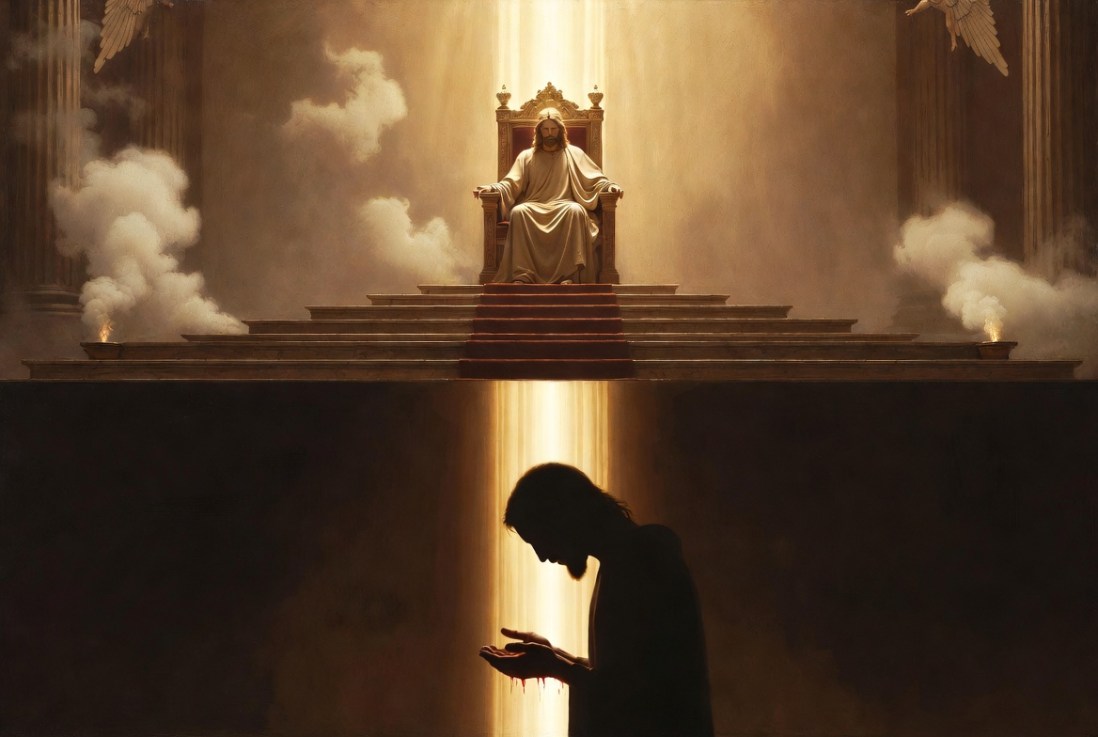
The third is John 1:14. The Word became flesh and ἐσκήνωσεν among us, and the disciples beheld his glory — δόξαν ὡς μονογενοῦς παρὰ πατρός. The verb ἐσκήνωσεν is built on the noun σκηνή (tabernacle), and reaches back through the Greek-speaking Jewish tradition to the Hebrew שָׁכַן (shakan, to dwell) and the cognate noun Shekinah — the divine indwelling glory that filled the tabernacle in Exodus 40:34–35 and the temple in 1 Kings 8:10–11, and that Isaiah saw filling the house in Isaiah 6:1. John 1:14 says that Shekinah has now tabernacled in human flesh. The doxa the disciples beheld in Jesus is named with the same Greek root as the temple-doxa Isaiah witnessed in his throne vision.
And the house was full of his glory (Isaiah 6:1). The same Shekinah that John 1:14 says has tabernacled in flesh.
These three texts converge. The doxa John attributes to Jesus in John 12:41 is the doxa of John 17:5 (pre-temporal, co-possessed, παρὰ σοί), of John 17:24 (eternally given, constitutive of identity), and of John 1:14 (Shekinah, the indwelling temple-glory of God). This is not a doxa that a created being can possess. The semantic range of doxa in the LXX includes human form, as the published case has rightly shown. Still, John has narrowed and intensified the term across his Gospel to refer specifically to the pre-temporal divine glory of the Son.
V. The Servant’s Glorification and Pre-Temporal Glory
The published case can grant Section IV in part and still preserve its central reading. It can say: yes, John has a high theology of the Son’s glory; yes, that theology is developed in John 17:5 and 1:14; but John 12:41 specifically refers to the Servant’s glorification in Isaiah 52–53, and that referent does not require Trinitarian metaphysics.
This is the move that must now be answered, and it is the pivot of the article.
Grant Isaiah 52–53 as the primary referent for “spoke about him.” Grant that John’s chapter-long δοξάζω and ὑψόω pattern climaxes at 12:41. Grant that what Isaiah saw included the Servant’s exaltation through suffering. The published case has earned all of this.
Now read the δοξασθήσεται of Isaiah 52:13 LXX through John 17:5.
If the glory Isaiah saw was the Servant’s glorification, and if John identifies that glory as belonging to Jesus (αὐτοῦ), and if Jesus’s own testimony about his glory in John 17:5 is that he possessed it παρὰ σοί before the foundation of the world, then the Servant’s glorification cannot be the elevation of a creature to a new status. It must be the manifestation in time of a glory that was already possessed before time. The Servant’s δοξασθήσεται is the temporal unveiling of pre-temporal doxa.
John 17:5 is not adjacent literature. It belongs to the same Gospel, by the same hand, narrating the same prayer of the same figure who is the αὐτοῦ of John 12:41. The Servant whose glorification Isaiah foresaw and the Son who prays in John 17 are one person. The doxa that the Servant receives in his exaltation is the doxa that the Son possessed in eternity. The two are not in tension; they are sequential disclosures of one reality.
This is why the published case’s strongest move — that “spoke about him” locates in Isaiah 52–53 — does not actually undermine the Trinitarian reading. It deepens it. If Isaiah saw the Servant’s glorification, what Isaiah saw was the eternal Son entering into the human path of doxa-through-suffering and emerging into the open manifestation of the doxa that was eternally his. Isaiah did not see two glories — a creaturely promotion and, somewhere else, a divine throne. Isaiah saw one glory, witnessed in two complementary visions across his prophetic book, that John says belonged to Jesus.
The Servant’s exaltation, read with John’s own theology in view, is not a creature receiving glory. It is the Son restoring what he never ceased to possess, made visible in flesh.
⁂
There is a response sometimes offered at this point that must be answered directly, because if it holds, it dissolves the entire pivot. The response is that John 17:5 can be read as glory possessed in the divine plan or in the Father’s foreknowledge rather than in actual pre-temporal existence — the glory the Father eternally decreed for the Messiah, possessed by him only in the divine intention. This reading does not survive contact with the Greek or with John’s wider theology of pre-existence.
The verb in John 17:5 is εἶχον, the imperfect indicative active of ἔχω. It denotes continuous past possession, not future-decreed allocation. John’s Gospel is grammatically capable of distinguishing what is known in advance from what is actually possessed: when he wants to describe foreknowledge, he uses different constructions. He chose εἶχον here. The prepositional construction παρὰ σοί reinforces the same point. παρὰ with the dative denotes presence-with, proximity-to, accompaniment — not predestined-for. And the prayer’s grammatical structure compounds the difficulty. The Son asks the Father to glorify him παρὰ σεαυτῷ — in your presence — with the glory he had παρὰ σοί before the world existed. The plan-reading collapses the prayer’s coherence: a Son cannot ask the Father to be relocated in the Father’s presence with glory that was merely decreed for him. He must have been in that presence previously, and the glory must have been his there. The prayer is a request for restoration, not for inheritance of a planned status.
The wider Johannine witness makes the plan-reading even less sustainable. John 8:58 places the speaker before Abraham with the existence-verb εἰμί — not “was decreed to be” but “I am.” John 1:1–2 places the Logos πρὸς τὸν θεόν in the beginning, not in the divine intention but in actual relational proximity. John 1:14, 3:13, 6:38, 6:62, 17:5, and 17:24 form a sustained network of pre-existence statements in which the Son speaks of having come from a place, having descended, having had glory, and having been with the Father before the world. To read all of this as figurative plan-language is to substitute a different Christology for John’s, not to interpret John’s. The plan-reading does not survive John’s grammar, his theology, or the structure of the high-priestly prayer.
The pivot therefore stands. The Servant whose glorification Isaiah foresaw is the Son who possessed glory παρὰ σοί before creation. The δοξασθήσεται of Isaiah 52:13 LXX is the temporal manifestation of pre-temporal δόξα — not the elevation of a creature.
VI. The Grammatical Anchor
Even with the Trinitarian argument carried by John’s own theology of doxa, the throne vision of Isaiah 6 is not exegetically absent from John 12:41. The relationship is best described not as quotation but as editorial parallel.
LXX Isaiah 6:1 reads, in the relevant portion: εἶδον τὸν κύριον καθήμενον ἐπὶ θρόνου ὑψηλοῦ καὶ ἐπηρμένου, καὶ πλήρης ὁ οἶκος τῆς δόξης αὐτοῦ. The verb of seeing is εἶδον; the genitive of glory is τῆς δόξης αὐτοῦ; the syntactic referent of αὐτοῦ is τὸν κύριον. The combined construction εἶδεν τὴν δόξαν αὐτοῦ is not present as a single clause in LXX Isaiah 6:1.
John 12:41 reads: ταῦτα εἶπεν Ἠσαΐας ὅτι εἶδεν τὴν δόξαν αὐτοῦ, καὶ ἐλάλησεν περὶ αὐτοῦ. The verb of seeing matches. The noun of glory matches. The third-person genitive pronoun matches. The construction is not a verbatim quotation of LXX Isaiah 6:1; it is John’s own editorial composition, drawing the verb and noun from Isaiah 6:1 into a single clause that names the figure whose glory was seen.
This is not the weakest form of intertextuality. It is John’s normal manner. John often constructs editorial statements that gather lexical material from multiple Isaianic locations into a Johannine theological synthesis. He has done this throughout the chapter with the δοξάζω and ὑψόω pair, gathering from Isaiah 52:13 LXX. He is doing it here with the seeing-glory pair, gathering from Isaiah 6:1 LXX.
The exegetical question is not whether John 12:41 is a verbatim quotation of Isaiah 6 (it is not), nor whether it is exclusively about Isaiah 6 (it is not), but what John is doing with the lexical material he has gathered from both Isaianic locations. The answer is: he is making a single editorial statement that identifies the doxa of Isaiah’s prophetic vision — both the throne-doxa of chapter 6 and the Servant-doxa of chapters 52–53 — as the doxa of Jesus.
This is a stronger reading than a verbatim-quotation claim, because it is what John actually wrote.
A reasonable challenge presses at this point: if the verse is not a quotation of Isaiah 6, on what non-circular basis does the article assert that Isaiah 6 is part of John’s lexical source-pool here? Two answers, each independent of the other. First, the co-occurrence of εἶδον and τῆς δόξης αὐτοῦ within a single verse of LXX Isaiah 6:1 is lexically unusual. The Septuagintal verb of theophanic seeing and the noun of divine glory do not cluster this densely elsewhere in the same prophet outside this verse. John’s reproduction of the same verb-and-noun pair in 12:41 is therefore distinctive intertextuality, not generic resemblance. Second, John has already set up the temple-doxa intertext in chapter 1: ἐσκήνωσεν names the Shekinah-doxa of the tabernacle and temple as the doxa his Gospel attributes to Jesus. Isaiah 6:1 is the foundational temple-theophany text in the Greek Bible. The doxa-of-the-temple connection is established by John in chapter 1 and recalled in chapter 12. The throne-vision link is not adventitious. It is anchored by Septuagintal lexical distinctiveness within Isaiah and by Johannine intratextuality across the Gospel.
VII. The Patristic Witness
The Trinitarian reading of John 12:41 is not a modern apologetic invention. Three independent witnesses, two Greek and one Latin, anchor it in the second-century church across both East and West.
The earliest is Justin Martyr. In Dialogue with Trypho 127, written in the mid-second century, Justin treats the throne vision of Isaiah Christologically. He argues that the figure visible to the prophets cannot be the unbegotten Father, who is invisible and not localized on a throne in a particular place; the visible one is the Logos, the Son.3 The argument is made on theological-metaphysical grounds — the Father’s invisibility — but its exegetical effect is to read Isaiah 6 as a vision of the pre-incarnate Logos. This is a full generation before any Trinitarian conciliar formula, and well within the apostolic memory of the Johannine community.
Irenaeus of Lyons, writing toward the end of the second century, makes the connection still more explicit. In Against Heresies 4.33.11, Irenaeus describes how the prophets each prefigured one aspect of Christ’s work. Some, he writes, “beholding Him in glory, saw His glorious life at the Father’s right hand.” The biblical citations Irenaeus gathers for that single sentence are Isaiah 6:1 and Psalm 110:1.4 Reading Isaiah’s throne vision as a beholding of the Son in glory is therefore not a later development; it is what Irenaeus, the disciple of Polycarp and the inheritor of Johannine apostolic memory through one intermediary, already names as the prophets’ work in the second century.
Tertullian of Carthage, writing Against Praxeas about 213, develops the same hermeneutic in the Latin West. In chapter 14 of that work, Tertullian argues that the patriarchs and prophets did see God — but the God whom they saw cannot be the Father, who is invisible by the testimony of Moses (Exodus 33:20) and of John (John 1:18). The visible one in the Old Testament theophanies is therefore the Son. Tertullian names Isaiah specifically among the prophets who saw God in this sense.5 The hermeneutic crosses the linguistic boundary cleanly: Greek (Justin, Irenaeus) and Latin (Tertullian), Asia Minor and Gaul, and North Africa, all converge on the same reading well before any conciliar formulation requires it.
This is the relevance for John 12:41. If Isaiah saw Jesus’s glory (as John 12:41 attests), and if the Father is invisible (as the second-century church argued from John 1:18 and parallel texts), then the figure Isaiah saw on the throne was the Son. John 12:41 is the apostolic seed; the second-century witnesses are its independent flowering across the early Christian world. Any unitarian reading of John 12:41 must therefore explain not only the Johannine text itself but also why the church of the second century — reading closer in time and culture to the Johannine community than any modern reader can — read the Isaianic theophany Christologically without controversy and without conciliar prompting. Three witnesses, in three regions, across two languages, in the lifetime of those who remembered the apostles, is not a coincidence to be brushed aside.
VIII. The Open Door
There is a temptation, when an argument has been carefully framed and a response carefully built, to close the door on the conversation. That is not what this article wants to do.
The published case has done something valuable. It has refused to let John 12:41 be flattened to a single proof-text. It has pressed the lexical range of doxa in the Greek Isaiah; it has identified the chapter-long pattern in John 12 that climaxes at the Servant’s glorification; it has named the genuine grammatical force of the “spoke about him” clause; it has raised the John 1:18 question with seriousness. A Trinitarian reading that ignores any of these is poorer for the ignoring.
What this article has argued is not that the published case is wrong about Isaiah 52–53. It is that John 12:41, even granting everything the published case has rightly observed, says something the published case has not fully reckoned with: that the doxa attributed to Jesus is, by the testimony of John’s own Gospel elsewhere, the pre-temporal Shekinah possessed παρὰ σοί before the foundation of the world. That datum is not in Isaiah; it is in John. And it changes what the Servant’s glorification means once John 12:41 names it as Jesus’s.
The throne vision of Isaiah 6 and the Servant Songs of Isaiah 52–53 are not two glories in competition. They are one glory in two registers: the eternal doxa of the Son seated above creation, and the temporal doxa of the same Son lifted up in flesh through the path of the cross. Isaiah saw both. John 12:41 names the one whose glory Isaiah saw — and across all the registers in which Isaiah saw it, the answer is the same.
This is the door the article holds open. The conversation about John 12:41 need not end in a forced choice between Isaiah 6 and Isaiah 52–53. It can end in the recognition that the figure on the throne and the Servant lifted up are the same one. That recognition is what the Christian tradition has called, from the apostles forward, the glory of the Son.
Sub tutela Dei
Footnotes
1. The paper engaged in this article is “Response to Dr. James White, Part Two: He Saw His Glory, and He Spoke About Him” (April–June 2007, revised July 2011). The detailed treatment of John 12:41 in question was present in the second edition of Jehovah’s Witnesses Defended but was withdrawn from the third edition; the 2007/2011 paper restored and developed the argument.
2. LXX Isaiah 6:1: εἶδον τὸν κύριον καθήμενον ἐπὶ θρόνου ὑψηλοῦ καὶ ἐπηρμένου, καὶ πλήρης ὁ οἶκος τῆς δόξης αὐτοῦ. The combined construction εἶδεν τὴν δόξαν αὐτοῦ as a single clause is John’s editorial composition (John 12:41), not a verbatim quotation of LXX Isaiah 6:1.
3. Justin Martyr, Dialogue with Trypho 127. Greek text in Goodspeed, Die ältesten Apologeten, 1915; English translation in Ante-Nicene Fathers, vol. 1.
4. Irenaeus of Lyons, Against Heresies 4.33.11. The phrase quoted (“beholding Him in glory, saw His glorious life at the Father’s right hand”) corresponds in Irenaeus to the conjoined citation of Isaiah 6:1 and Psalm 110:1. Latin text in Sources Chrétiennes 100; English translation in Ante-Nicene Fathers, vol. 1.
5. Tertullian, Against Praxeas 14. Latin text in Corpus Christianorum Series Latina, vol. 2; English translation in Ante-Nicene Fathers, vol. 3. The chapter argues from Exodus 33:20 and John 1:18 that the figure seen by the patriarchs and prophets is the Son, not the Father.


Leave a Reply