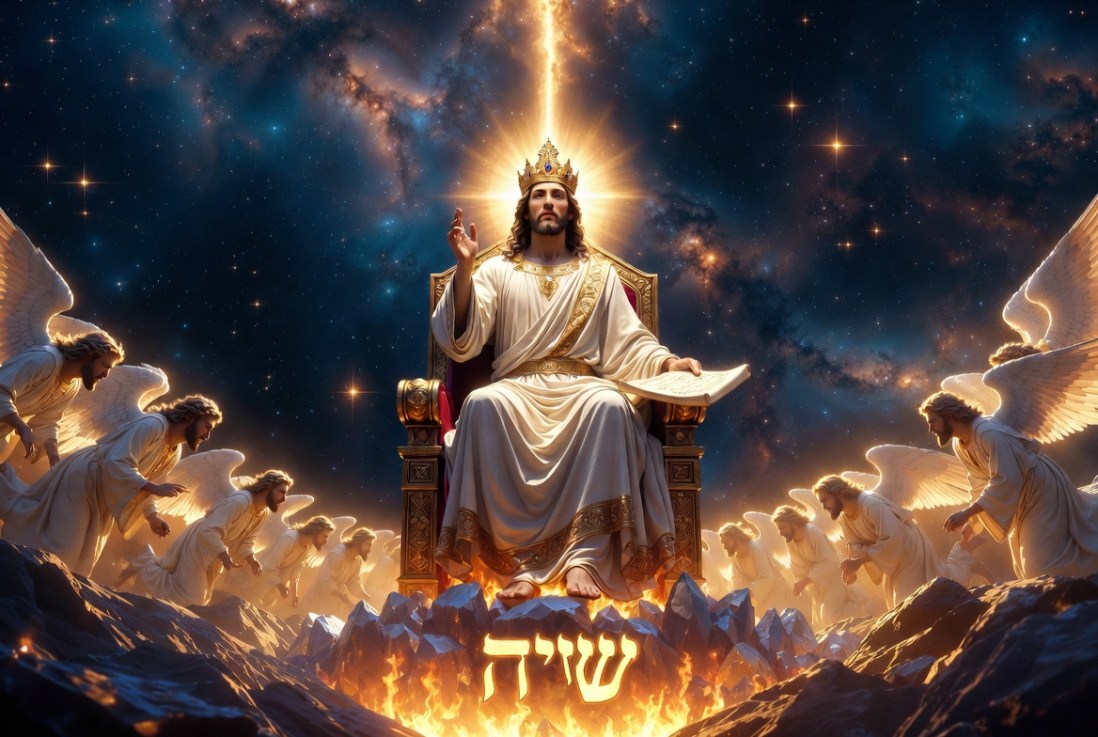
The inspired Scriptures do not present Jesus Christ merely as a human Davidic king, a plenipotentiary of God, or an exalted creature. They present him as God Almighty incarnate — the eternal King who was, is, and is to come. This article examines the Hebrew and Greek evidence from the Old and New Testaments, traces the patristic reception of these texts, and demonstrates that the eternal reign of YHWH and the eternal reign of Christ are one and the same reign, because Christ is one and the same God.
From the opening chapters of Genesis to the closing visions of Revelation, the Hebrew and Christian Scriptures converge on a single, inescapable claim: there is one eternal King, and his name is YHWH — the self-existent, uncreated God who reigns from everlasting to everlasting. Yet the same Scriptures foretell, with startling precision, that this eternal sovereign would be born as a Child, bear the divine title Mighty God, and rule on David’s throne with no end to his kingdom. The New Testament identifies that Child as Jesus of Nazareth — and applies to him, without remainder or reduction, every prerogative of divine kingship the Hebrew Bible reserves for YHWH alone.
This article will demonstrate that claim from the Scriptures themselves. We will examine what the Hebrew says in regard to the reign of YHWH, compare it with the way the New Testament depicts Christ’s dominion over all creation, trace the meaning of the divine title El Gibbor in its linguistic and ancient Near Eastern context, and show how the Church Fathers — from Justin Martyr and Irenaeus in the second century to Athanasius, Chrysostom, and Cyril of Alexandria in the fourth and fifth — unanimously received these texts as unambiguous testimony to the full divinity of Jesus Christ.
I
YHWH: The Everlasting King
The Hebrew Bible establishes, with overwhelming consistency, that YHWH is not merely a king among kings but the eternal, uncreated sovereign whose throne was never established and will never be overthrown, because it belongs to eternity itself. This is not an incidental theme. It is a structural pillar of Israelite monotheism:
“Yahweh shall reign forever and ever.”Exodus 15:18
“But Yahweh abides forever; He has established His throne for judgment.”Psalm 9:7
“Yahweh is King forever and ever; Nations have perished from His land.”Psalm 10:16
“Yahweh sat enthroned over the flood; Indeed, Yahweh sits as King forever.”Psalm 29:10
“He rules by His might forever; His eyes keep watch on the nations; Let not the rebellious exalt themselves.”Psalm 66:7
“Yahweh reigns, He is clothed with majesty; Yahweh has clothed and girded Himself with strength; Indeed, the world is established, it will not be shaken. Your throne is established from of old; You are from everlasting.”Psalm 93:1–2
“Your kingdom is an everlasting kingdom, and Your dominion endures from generation to every generation.”Psalm 145:13
“But Yahweh is the true God; He is the living God and the everlasting King.”Jeremiah 10:10
“You, O Yahweh, sit enthroned forever; Your throne is from generation to generation.”Lamentations 5:19
“He is the living God and enduring forever, and His kingdom is one which will not be destroyed, and His dominion will be unto the end.”Daniel 6:26
Everlasting kingship, in the Hebrew Bible, is an exclusively divine prerogative. No creature is said to reign forever and ever. No angelic being sits enthroned from everlasting. This register of language — eternal throne, kingdom without end, sovereign over all nations — is reserved for YHWH alone.
This is precisely what makes what follows so theologically explosive.
II
The Child Born as Mighty God (El Gibbor)
The prophet Isaiah, writing in the eighth century BC, foretold the birth of a Child who would reign on David’s throne — and who would bear as one of his official throne names the title El Gibbor: Mighty God.
“For a child will be born to us, a son will be given to us; And the government will rest on His shoulders; And His name will be called Wonderful Counselor, Mighty God, Eternal Father, Prince of Peace. There will be no end to the increase of His government or of peace, on the throne of David and over his kingdom, to establish it and to uphold it with justice and righteousness From then on and forevermore. The zeal of Yahweh of hosts will accomplish this.”
Isaiah 9:6–7
Linguistic Note · אֵל גִּבּוֹר · El Gibbor
What Does El Gibbor Mean?
El (אֵל) derives from the Proto-Semitic root ʔil-, cognate with Ugaritic il, Akkadian ilum, and Phoenician ʾl — all meaning “god” or “deity.” An older hypothesis linking it to ʾayil (“ram”) as a symbol of strength is now abandoned in contemporary Semitic linguistics (HALOT, BDB, DCH). The semantic range of power is real but represents a secondary association, not the word’s derivation. Jerome, in his Liber Interpretationis Hebraicorum Nominum, glosses el as fortis or deus.
Gibbor (גִּבּוֹר) is a qal active participle / verbal adjective (the qōṭēl pattern, with gemination of the middle radical for intensity) from the root gabar (גָּבַר), meaning “to be strong,” “to prevail,” “to overcome.” The gemination marks it as the epitome of prevailing might — the one who conquers absolutely. Cognates appear in Aramaic, Syriac, and Arabic (jabbar, via the Semitic g→j shift). Ugaritic attests gbr as a heroic epithet in the Canaanite divine-king tradition, confirming the root’s antiquity and martial force.
The compound el gibbor is a nominal phrase — not a construct chain — in which gibbor functions attributively, yielding “Mighty God” or “Warrior God.” It is rare precisely because it is not a common idiom. Its scarcity is part of its rhetorical weight. Scholarly consensus recognizes that it invokes the full force of divine omnipotence, not merely political power.
The Isaiah 9–10 Echo
Just twelve verses after applying El Gibbor to the Child in 9:6, Isaiah uses the identical title for YHWH himself:
“A remnant will return, the remnant of Jacob, to the mighty God.”
Isaiah 10:21
This is not accidental. Isaiah’s literary design is deliberate: the Messiah bears the divine name because the Messiah is divine. He is not a powerful human king to whom God lends strength. He is the Mighty God himself, born into the human family, to reign on David’s throne from then on and forevermore. YHWH is called El Gibbor in Isaiah 10:21. The Child is called El Gibbor in Isaiah 9:6. These are the same title, deliberately placed within chapters of each other.
The same deliberate pattern appears elsewhere: Jeremiah 32:18 uses ha-el hagadol hagibbor for YHWH; Deuteronomy 10:17 and Nehemiah 9:32 repeat the identical formula in solemn prayer. And Zephaniah 3:17 applies the title in its most striking eschatological form: YHWH gibbor yoshia — “YHWH the Mighty One will save” — the divine Warrior delivering Zion in triumph, a register directly parallel to Isaiah 9’s royal Child who establishes justice and peace on David’s throne.
Patristic Reception Irenaeus of Lyon (Against Heresies III.16.3; Proof of the Apostolic Preaching §56) explicitly applied “Mighty God” to the incarnate Son, arguing that the title refers to his divine nature. Tertullian (Against Marcion III.12; Against Praxeas 11) cited Isaiah 9:6 against both docetism and Sabellianism. Origen (Contra Celsum I.49) held that “Mighty God” demonstrates the Son’s genuine divine power — not delegated authority. Chrysostom (Homilies on Matthew 8.2) pointed to the Isaiah 9–10 literary echo as intentional, foreclosing any diminished reading. Leo the Great (Sermon XXVI on the Nativity) preached that the nativity of the one “called Mighty God” is the nativity of the eternal Son taking human form — not the beginning of his existence, but the beginning of his visibility in the flesh.
III
The Fulfillment: Jesus of Nazareth
The New Testament identifies Jesus as this very Child, born in Galilee precisely as Isaiah foretold, ruling on David’s throne with no end to his kingdom:
“He will be great and will be called the Son of the Most High, and the Lord God will give Him the throne of His father David, and He will reign over the house of Jacob forever, and there will be no end of His kingdom.”
Luke 1:32–33
“The people who were sitting in darkness saw a great Light, And those who were sitting in the land and shadow of death, Upon them a Light dawned… Repent, for the kingdom of heaven is at hand.”
Matthew 4:16–17 — fulfilling Isaiah 9:1–2
The geographic specificity matters. Isaiah named Zebulun and Naphtali — the region of Galilee — as the place where the great light would dawn. Matthew records that Jesus relocated there precisely to begin his public ministry, and explicitly identifies it as the fulfillment of Isaiah’s prophecy. Every element converges on one person.
“The kingdom of the world has become the kingdom of our Lord and of His Christ, and He will reign forever and ever.”
Revelation 11:15
The language of Exodus 15:18 — YHWH shall reign forever and ever — is transferred to the Lord and his Christ without remainder or reduction.
IV
The Stone and the Son of Man: Daniel’s Two Visions
The Stone That Becomes a Mountain
Isaiah was not the only prophet who foresaw a divine King whose kingdom would fill the earth and never be destroyed. Daniel saw it twice — first in the image of a stone:
“The stone that struck the image became a great mountain and filled the whole earth… And in the days of those kings the God of heaven will cause a kingdom to rise up which will never be destroyed… it will itself stand forever.”
Daniel 2:35, 44
The New Testament is unambiguous about the identity of this stone:
“He is the stone which was rejected by you, the builders, but which became the chief corner stone. And there is salvation in no one else, for there is no other name under heaven that has been given among men by which we must be saved.”
Acts 4:11–12
The Son of Man Who Receives Eternal Worship
“I saw one like a son of man coming. He came to the Ancient of Days, and he was brought before him. To him was given dominion, honor, and a kingdom. All peoples, nations, and languages will worship (yipelachun) him. His dominion is an eternal dominion that will not pass away, and his kingdom is one that will not be destroyed.”
Daniel 7:13–14 (EHV)
The Aramaic verb rendered “worship” is pelach (פְּלַח) — the same cultic term used in Daniel 3 for worship of Nebuchadnezzar’s golden statue and in Daniel 6 for Daniel’s worship of his God. It is not the language of political service or royal homage. It is the language of divine cultic veneration. The Theodotion Greek recension — the standard Christian LXX text of Daniel — renders it latreuousin: the Greek word consistently used throughout the Septuagint for the exclusive worship due to God alone, latria.
Patristic Reception — Daniel 7 Justin Martyr (Dialogue with Trypho 31–32) identified the Son of Man as the pre-existent Christ, arguing that the worship rendered to him is identical to that rendered to the Father. Hippolytus of Rome, in his Commentary on Daniel — the earliest surviving commentary on any biblical book — insisted that the Son of Man’s eternal dominion is divine dominion, not angelic or creaturely authority. Athanasius (Contra Arianos I.37–38) used Daniel 7 against Arian diminishment: the Son of Man’s reception of eternal dominion is not a promotion — it is the manifestation of what he always was.
Jesus Identifies Himself as Daniel’s Son of Man
“Are You the Christ, the Son of the Blessed One?” And Jesus said, “I am; and you shall see the Son of Man sitting at the right hand of the Power, and coming with the clouds of heaven.”
Mark 14:61–62
The high priest understood immediately what was being claimed. He tore his robes. He did not hear a man claiming to be a great prophet or national liberator. He heard someone claiming to be the divine figure of Daniel 7 — the one to whom eternal dominion and universal worship belong. He was wrong about the conclusion, but precisely right about what was being claimed.
“Do not fear; I am the first and the last, and the living One; and I was dead, and behold, I am alive forever and ever, and I have the keys of death and of Hades.”
Revelation 1:17–18
V
The Theophanies: Isaiah Saw Christ’s Glory
One of the most remarkable confirmations of Christ’s divine identity comes from the Apostle John’s commentary on Isaiah’s vision in the Temple:
“These things Isaiah said because he saw his glory and spoke of him.”
John 12:41
The context is decisive. John has just quoted from Isaiah 6 — the famous Temple vision in which the prophet beholds YHWH Sabaoth enthroned, his glory filling the Temple, attended by seraphim crying Holy, holy, holy. John identifies this vision of YHWH’s glory as a vision of Christ’s glory. The divine majesty Isaiah saw in the throne room was the glory of the eternal Son. The pre-incarnate Christ appeared to Isaiah as YHWH enthroned — because he is YHWH, the second Person of the Holy Trinity, sharing fully in the divine nature.
VI
Christ Enthroned at the Right Hand of the Majesty on High
The Hebrew Bible is explicit: YHWH alone reigns from the heavens, and the earth he has given to the sons of men (Psalm 115:16). No creature ascends to that throne. And yet the New Testament presents the risen Christ as doing exactly that:
“He worked in Christ, by raising Him from the dead and seating Him at His right hand in the heavenly places, FAR ABOVE ALL rule and authority and power and dominion, and EVERY NAME that is named, not only in this age but also in the one to come. And He put ALL THINGS in subjection under His feet, and gave Him as head OVER ALL THINGS to the church, which is His body, the fullness of Him who fills all in all.”
Ephesians 1:20–23
The author of Hebrews makes the theological logic explicit by reaching for the precise words of the Greek Psalter. He describes the Son as the one who “sat down at the right hand of the Majesty on high (en hypselois)” — then notes that this same phrase, en hypselois, is the LXX’s description of YHWH’s unique transcendence in Psalm 113:5: “Who is as the Lord our God? who dwells in the high places (en hypselois).”
By applying YHWH’s transcendent position to the exalted Christ, Hebrews situates Jesus within the uniquely divine station — not beneath it. Gregory of Nyssa (Against Eunomius III.3) was clear: no creature sits in that position. The Son’s session there is as natural to him as the Father’s, because they share one divine nature.
VII
“Your Throne, O God, Is Forever and Ever”: Psalm 45 and Hebrews 1
The most direct divine address in the entire Psalm tradition occurs in Psalm 45, and the Epistle to the Hebrews applies it unambiguously to the Son of God:
“Your throne, O God (elohim), is forever and ever; A scepter of uprightness is the scepter of Your kingdom. You have loved righteousness and hated wickedness; Therefore God, Your God, has anointed You with the oil of joy above Your companions.”
Psalm 45:6–7
“But of the Son He says, ‘Your throne, O God (ho theos), is forever and ever, And the scepter of uprightness is the scepter of Your kingdom. You have loved righteousness and hated lawlessness; Therefore God, Your God, has anointed You with the oil of gladness above Your companions.’”
Hebrews 1:8–9
This is the Father’s own address to the Son. The Father calls the Son “O God.” He acknowledges the Son’s eternal throne. The anointing language — “God, your God, has anointed you” — refers, as the Fathers unanimously agreed, to the Son’s human nature receiving anointing in the Incarnation, while the address “O God” affirms his divine nature without qualification.
Patristic Reception — Psalm 45 / Hebrews 1:8–9 Athanasius (Contra Arianos I.46; II.15): The anointing does not imply inferiority of nature but refers to the Incarnation. The Psalm addresses the Son directly as God. Augustine (Enarrationes in Psalmos on Psalm 44 [45]): No creature can be addressed as “O God” with a throne that is eternal and a scepter that is upright. Chrysostom (Homilies on Hebrews, Homily 2): The Son is categorically unlike the angels. He is addressed as God. Cyril of Alexandria (Thesaurus de Sancta Trinitate): The Father formally acknowledges the Son’s divinity in this address. Gregory of Nazianzus (Theological Oration IV [Oration 30], §5): Listed Psalm 45:6–7 / Hebrews 1:8–9 among his central proof texts for the Son’s full divinity.
VIII
The Divine Name: Alpha and Omega, First and Last
The book of Revelation adds one further identification, precise yet theologically decisive. YHWH declares in Isaiah:
“I am the first and I am the last; besides me there is no god.”
Isaiah 44:6
In Revelation 1:8, the Lord God Almighty claims the title “Alpha and Omega.” In Revelation 1:17, the risen Christ — the Son of Man — declares: “I am the first and the last, and the living One.” And in Revelation 22:12–16, the one who announces his imminent return to judge — explicitly identified as “I, Jesus” — declares:
“I am the Alpha and the Omega, the first and the last, the beginning and the end.”
Revelation 22:13
The risen Christ appropriates the divine self-identification that YHWH uses in Isaiah 44:6 to assert his unique, exclusive deity — the declaration that beside him there is no god. In Revelation, that declaration rests on the lips of Jesus. This is not a metaphor. This is the conscious, deliberate transfer of YHWH’s most exclusive title to the crucified and risen Son of God.
IX
The Kenosis and the Exaltation: Philippians 2
“Who, being in very nature God, did not consider equality with God something to be used to his own advantage; rather, he made himself nothing by taking the very nature of a servant, being made in human likeness. And being found in appearance as a man, he humbled himself by becoming obedient to death — even death on a cross! Therefore God exalted him to the highest place and gave him the name that is above every name, that at the name of Jesus every knee should bow, in heaven and on earth and under the earth, and every tongue acknowledge that Jesus Christ is Lord, to the glory of God the Father.”
Philippians 2:6–11 (NIV)
Three things must be noted. First, the one who “makes himself nothing” is one who was “in very nature God” (en morphē theou hyparchōn) — the present participle indicates a continuous, abiding state. He did not temporarily possess divinity. He is divine by nature, permanently and essentially. Second, the kenosis is not an emptying of divinity but of the visible exercise of divine prerogatives: Cyril of Alexandria (On the Unity of Christ) was precise — the Son did not cease to be God when he became man; he voluntarily veiled his glory. Maximus the Confessor (Ambigua 5) went further: the exaltation is the full manifestation of what the hypostatic union always contained. Third, the “name above every name” — Kyrios, Lord, the Greek equivalent of YHWH — now confessed universally by every creature is the same confession Isaiah demanded for YHWH alone (Isaiah 45:23). Every knee that bows at the name of Jesus is bowing to the one the Hebrew Bible always said would receive that universal homage.
X
The New Testament’s Explicit Divine Titles for Christ
The New Testament does not leave us to inference. Multiple passages apply the divine title theos — God — directly and unambiguously to Jesus Christ:
“From their race, according to the flesh, is the Christ, who is God over all, blessed forever. Amen.”
Romans 9:5 (ESV)
“No immoral, impure, or greedy person — such a person is an idolater — has an inheritance in the kingdom of Christ, who is God (tou Christou kai theou).”
Ephesians 5:5 (EHV)
“while we wait for the blessed hope, that is, the glorious appearance of our great God and Savior, Jesus Christ (tou megalou theou kai sōtēros hēmōn Iēsou Christou).”
Titus 2:13–14 (EHV)
“by the righteousness of our God and Savior, Jesus Christ (tou theou hēmōn kai sōtēros Iēsou Christou).”
2 Peter 1:1
“grow in the grace and knowledge of our Lord and Savior Jesus Christ. To Him be the glory, both now and to the day of eternity. Amen.”
2 Peter 3:18
The Granville Sharp construction in Titus 2:13 — theou kai sōtēros with a single definite article governing both nouns — grammatically requires that “God” and “Savior” refer to one and the same person, Jesus Christ. Catholic exegesis (the Catechism, §449, cites Romans 9:5 directly) accepts this construction and its implications. Orthodox theology concurs without reservation.
Conclusion
The Eternal God-Man Who Reigns Forever
The biblical case is cumulative and convergent. YHWH alone reigns forever and ever. Isaiah prophesied that a Child would be born bearing YHWH’s own title, El Gibbor, and would rule on David’s throne for all eternity. The same prophetic tradition in Daniel saw a Stone that would fill the earth and never be destroyed, and a Son of Man who would receive eternal dominion and universal divine worship from all peoples, nations, and languages. The New Testament identifies Jesus of Nazareth as the fulfillment of each vision: the divine Child of Isaiah, the Stone of Daniel’s dream, the Son of Man of Daniel’s night vision, the one whom Isaiah saw in the Temple as YHWH Sabaoth, the one seated at the right hand of the Majesty on high, the Alpha and the Omega, the First and the Last — God over all, blessed forever.
The reason Jesus can inherit and fulfill every promise of YHWH’s eternal kingship is not that he was promoted to a position his nature did not warrant. It is that he is, by nature, the eternal Son of God — the Second Person of the Holy Trinity — who became flesh without ceasing to be divine. The mystery of the Hypostatic Union, defined at Chalcedon in AD 451, precisely captures what Scripture had been testifying all along: one Person, two natures — fully divine, fully human — without confusion, change, division, or separation.
When Isaiah says the Mighty God will reign on David’s throne forever, he is not describing a contradiction. He is describing the Incarnation — the Eternal entering time, the Almighty taking on flesh — so that the everlasting kingdom of YHWH and the everlasting kingdom of David’s son would be, in the one God-Man, one and the same kingdom.
“To Him be the glory, both now and to the day of eternity. Amen.”
2 Peter 3:18
Unless otherwise noted, scriptural quotations are from the Legacy Standard Bible (LSB). Other translations cited: English Standard Version (ESV); Evangelical Heritage Version (EHV); New International Version (NIV).


Leave a Reply