The New Passover: Heaven, History, and the Heart of Holy Week
A Holy Week Reflection · Catechesis for All the Faithful
A catechetical reflection drawing on Sacred Scripture, the Catechism of the Catholic Church, and the witness of the Church Fathers
There is a thread woven through all of history — from the cries of enslaved Israelites in ancient Egypt to the whispered prayers of believers in every age — and that thread is the love of God reaching into darkness to set his people free. Holy Week is not simply a remembrance of events that happened two thousand years ago. It is the culmination of a story that began long before Bethlehem, a story whose first chapter was written in blood on the doorposts of Egypt.
To understand what Christ accomplished in his Passion, Death, and Resurrection, the Church has always turned first to the Exodus. This is not a coincidence, nor is it merely a poetic parallel. God himself designed history so that the liberation of Israel from Egypt would be a living blueprint — what theologians call a type or prefiguration — of the far greater liberation that his Son would accomplish for all humanity. The Catechism of the Catholic Church teaches directly:
“The Church, as early as apostolic times, and then constantly in her Tradition, has illuminated the unity of the divine plan in the two Testaments through typology, which discerns in God’s works of the Old Covenant prefigurations of what he accomplished in the fullness of time in the person of his incarnate Son.”
Catechism of the Catholic Church, §128
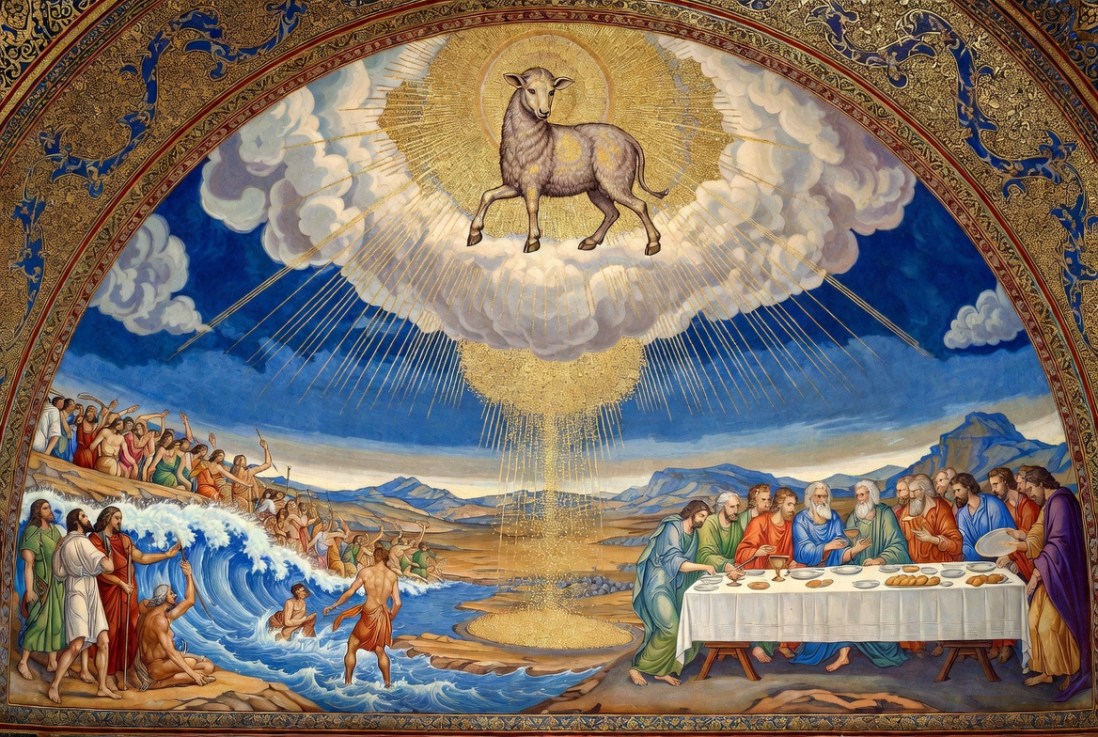
To read the story of the Passover and the Exodus is, for the Christian, to read the story of our own salvation written in advance. And to understand Maundy Thursday — the night of the Last Supper — is to see that ancient story reach its fulfillment in a single upper room in Jerusalem.
✦
Part One: The Night Heaven Came Down
Most of us know the broad outlines of the Exodus: the enslaved people of Israel, the plagues God sent against Egypt, the Passover lamb whose blood protected the firstborn, the crossing of the Red Sea, and the long journey through the wilderness toward the Promised Land. But the Scripture reveals something astonishing about the night of the first Passover that often goes unnoticed: it was not simply a human or even an angelic event. It was a night on which all of heaven came down.
When Deuteronomy 33:2 recounts that God came from Sinai, it adds that he came with myriads of holy ones — literally, tens of thousands of his heavenly host. The Psalms echo this. Psalm 68:17–18 reflects on the same event:
“The chariots of God are twice ten thousand, thousands upon thousands; the Lord came from Sinai into the holy place.”
Psalm 68:17–18
And the Book of Daniel (7:10) paints a picture of the heavenly court: “A thousand thousands served him, and ten thousand times ten thousand stood before him.” These are not decorative details. They tell us that the night of the Passover was an event of such cosmic magnitude that the entirety of the heavenly court was present.
The New Testament confirms that the giving of the Law at Sinai was mediated by angels in the plural (Acts 7:53, Galatians 3:19, Hebrews 2:2). The writer of Hebrews tells his readers that they have come “to Mount Zion and to the city of the living God, the heavenly Jerusalem, and to innumerable angels in festal gathering” (Hebrews 12:22) — the same host that accompanied God in the Exodus, now gathered in the heavenly Jerusalem around Christ.
But there is more. The Holy Spirit was not absent from the Exodus either. Isaiah, reflecting back on that period, writes: “He put in the midst of them his holy spirit” (Isaiah 63:11), and again, “the Spirit of the Lord gave them rest” (Isaiah 63:14). During the wilderness journey, God told Moses he would take “some of the Spirit” that rested on Moses and place it upon the seventy elders, who then prophesied (Numbers 11:16–29). Nehemiah’s great prayer of repentance recalls: “Thou gavest thy good Spirit to instruct them” (Nehemiah 9:20).
The entire Holy Trinity — Father, Son, and Spirit — was present and active in the liberation of Israel from Egypt. And at the center of that event, executing the judgment of God on the night of the Passover, was the eternal Word of God himself.
The Almighty Word Who Leapt from the Throne
Who was the destroyer who passed through Egypt on Passover night, bringing death to the firstborn of every household that had not marked its doorposts with the blood of the lamb? The Book of Exodus (12:23) tells us it was the Lord passing through. But one of the deuterocanonical books — the Wisdom of Solomon, which is part of the canon of both the Catholic and Orthodox churches — gives us an extraordinary vision of what actually happened:
“For while gentle silence enveloped all things, and night in its swift course was now half gone, thy all-powerful word leaped from heaven, from the royal throne, into the midst of the land that was doomed, a stern warrior carrying the sharp sword of thy authentic command, and stood and filled all things with death.”
Wisdom of Solomon 18:14–16
The “Almighty Word” who leapt from the royal throne of God to execute judgment on Egypt — this is the pre-incarnate Son of God, the same Word who would one day become flesh in the womb of Mary (John 1:14). The Catholic Encyclopedia confirms that “passages of the Book of Wisdom (ii, 13, 16–18; xviii, 14–16) find their fulfilment in Christ, the Incarnate ‘Word’ and ‘the Wisdom of God.’” The Catholic liturgy itself has long adapted Wisdom 18:14–15 for the Christmas season, recognizing that the same Word who leapt from the throne in judgment at the Exodus also leapt from the throne in mercy at the Incarnation — “while gentle silence enveloped all things” — to save us all.
The connection is breathtaking: the Blood of the Lamb that protected Israel from the destroying Word was itself a type and shadow of the Blood of the true Lamb — Christ himself — that now protects every soul from judgment and death.
✦
Part Two: The New Exodus — Reading the New Testament Through Exodus Eyes
With this background in place, the New Testament opens up in an entirely new way. The earliest Christians, steeped in the Hebrew Scriptures, could not read the story of Jesus without immediately recognizing the Exodus pattern being fulfilled before their eyes.
At the Transfiguration, when Moses and Elijah appear to Jesus on the mountain in glory, what do they speak about with him? Luke tells us: “they spoke of his departure, which he was to accomplish at Jerusalem” (Luke 9:31). The English word “departure” translates the Greek exodon — the very word used for the book of Exodus, the second book of Moses. Moses and Elijah were speaking with Jesus about his Exodus. Just as Moses led the first exodus from Egyptian bondage, Jesus was about to lead a new and greater exodus — from the bondage of sin and death itself — accomplished not through the waters of the Red Sea but through the waters of Baptism, not sealed by the blood of bulls but by his own most precious Blood.
This New Exodus framework shapes the entire Gospel of Matthew, which deliberately structures Jesus’s life to mirror Moses’s: the flight into Egypt and return (Matthew 2:13–15), the forty days in the wilderness echoing Israel’s forty years (Matthew 4:1–2), and the Sermon on the Mount as a new giving of the Law from a new mountain. It permeates the Gospel of John, with its themes of manna, light, water, and liberation. And it is the explicit interpretive lens of the Letter to the Hebrews, which presents Christ as the true High Priest, the true Passover sacrifice, and the mediator of a new and better covenant.
The early Church Father Origen of Alexandria (c. 184–253 AD) drew out these connections in his homilies on Exodus, seeing in every detail of the Israelite journey a spiritual teaching about the Christian life. St. Augustine (354–430 AD) wrote extensively on the sacramental meaning of the Exodus events. And both the Catholic and Orthodox traditions have never ceased to read the Passover as the great prophetic template for what Christ accomplished.
The New Pharaoh, the New Egypt, and the New Wilderness
Every Exodus has a Pharaoh. In the New Exodus, Scripture identifies our enslaver by name. Ezekiel (29:3) describes the Pharaoh of Egypt as “the great dragon that lies in the midst of his streams,” and the Book of Revelation (12:9) identifies that great dragon as “the ancient serpent, who is called the devil and Satan, the deceiver of the whole world.” Pharaoh, in the typological reading, is Satan — the one who holds humanity captive, who whispers that we belong to him, that we cannot be free.
But the Christian is not without hope. Just as the blood of the Passover lamb protected Israel from the destroyer, so the Blood of Christ — shed freely and offered to all — is what breaks every chain. Paul writes to the Colossians: “He has delivered us from the dominion of darkness and transferred us to the kingdom of his beloved Son, in whom we have redemption, the forgiveness of sins” (Colossians 1:13–14). This is the New Exodus: the transfer from one kingdom to another, from slavery to sonship, from darkness to light.
As for the wilderness — the long journey between Egypt and the Promised Land — this, too, has its New Testament counterpart. The Christian life in this world is the wilderness period. We have been set free, but we have not yet arrived at our heavenly homeland. We are pilgrims, strangers, and sojourners — sustained every day, as we shall see, by supernatural food.
“To read the story of the Passover and the Exodus is, for the Christian, to read the story of our own salvation written in advance.”
✦
Part Three: The Sacraments as the New Exodus Lived
Baptism: The Crossing of the Red Sea
If the Exodus is the blueprint of salvation, then Baptism is the crossing of the Red Sea. This is not a pious metaphor invented by later theologians — it is the explicit teaching of the Apostle Paul, written under the inspiration of the Holy Spirit:
“I want you to know, brethren, that our fathers were all under the cloud, and all passed through the sea, and all were baptized into Moses in the cloud and in the sea, and all ate the same spiritual food, and all drank the same spiritual drink. For they drank from the spiritual Rock that followed them, and the Rock was Christ.”
1 Corinthians 10:1–4
Israel’s passage through the Red Sea — through which they were separated from Egypt and united to Moses their deliverer — was their baptism. The waters that drowned Pharaoh’s army and separated Israel forever from their enslavers are a type of the waters of Baptism, through which the baptized person is buried with Christ and raised to new life (Romans 6:3–4), separated from the dominion of sin and united to Christ their Saviour.
The Catechism of the Catholic Church makes this connection explicitly: “The crossing of the Red Sea literally prefigures the liberation wrought by Baptism”(CCC §1221). Both the Catholic and Orthodox traditions celebrate this connection liturgically, reading from Exodus during the Easter Vigil precisely to help those about to be baptized understand what is happening to them: they are crossing through the Red Sea, leaving Egypt behind, entering the pilgrim journey of the Christian life under the guidance of a new Moses — Jesus Christ.
The Eucharist: The New Manna
In the wilderness, God fed the Israelites with manna — a mysterious, bread-like substance that appeared each morning with the dew (Exodus 16). The Psalmist calls it “the bread of angels” (Psalm 78:25). It was supernatural food that sustained the people throughout their forty years of wandering — every single day, without fail.
Jesus himself tells us plainly what the manna was pointing toward. In the great Bread of Life discourse (John 6), he says:
“Your fathers ate the manna in the wilderness, and they died. This is the bread which comes down from heaven, that a man may eat of it and not die. I am the living bread which came down from heaven; if anyone eats of this bread, he will live forever; and the bread which I shall give for the life of the world is my flesh.”
John 6:49–51
The manna was real bread that sustained mortal life. The Eucharist is the true bread that sustains eternal life. The manna was given daily to sustain the pilgrim people in the wilderness; the Eucharist is given to the Church — the new Israel on pilgrimage through the world — to sustain them until they reach the heavenly Jerusalem. The Catechism teaches: “The Eucharist is the memorial of Christ’s Passover, the making present and the sacramental offering of his unique sacrifice, in the liturgy of the Church which is his Body”(CCC §1362).
The Blood of the Covenant: Old and New
On the night before Israel left Egypt, Moses ratified the covenant between God and the people by sprinkling them with the physical blood of sacrificed animals:
“Moses took the blood and threw it upon the people, and said, ‘Behold the blood of the covenant which the Lord has made with you.’”
Exodus 24:8
The blood had to physically touch the people. It was not merely symbolic — it was a real, sacramental action in which the covenant was sealed by contact with blood. On the night of the Last Supper — the night we call Maundy Thursday — Jesus took a cup and said: “This is my blood of the covenant, which is poured out for many for the forgiveness of sins” (Matthew 26:28). The echo of Moses is unmistakable. Jesus is instituting a new covenant, ratified not by the blood of bulls but by his own Blood — and he gives his disciples a way to receive that Blood, to have it enter and become part of them, through the cup of the Eucharist.
The Letter to the Hebrews draws all of this together in a passage of extraordinary beauty:
“But you have come to Mount Zion and to the city of the living God, the heavenly Jerusalem, and to innumerable angels in festal gathering, and to the assembly of the firstborn who are enrolled in heaven, and to a judge who is God of all, and to the spirits of just men made perfect, and to Jesus, the mediator of a new covenant, and to the sprinkled blood that speaks more graciously than the blood of Abel.”
Hebrews 12:22–24
When we receive the Eucharist, we enter a reality that spans heaven and earth. We join the festal gathering of angels. We are united with the saints who have gone before us. We receive the sprinkled blood of Jesus, which — unlike Abel’s blood, which cried out for vengeance — cries out for mercy, for forgiveness, for life.
✦
Part Four: The Heart of Jesus — The Story of Judas
No meditation on Maundy Thursday is complete without turning to the most heartbreaking figure of that night: Judas Iscariot. And no figure reveals the unlimited, unconditional love of Jesus more starkly than the man who would betray him.
How Does a Disciple Become a Betrayer?
The Gospel of John gives us a devastating detail about Judas that explains how his fall began: “He was a thief, and as he had the money box he used to take what was put into it” (John 12:6). Judas had been given responsibility over the finances of the apostolic community. And he stole from it — quietly, consistently, secretly.
St. Paul names precisely what happened to Judas: “Put to death therefore what is earthly in you: fornication, impurity, passion, evil desire, and covetousness, which is idolatry” (Colossians 3:5). And again: “For you may be sure of this, that everyone who is covetous (that is, an idolater) has no inheritance in the kingdom of Christ and God” (Ephesians 5:5).
Greed is idolatry. When money becomes the center of a person’s life — the thing they will do anything to acquire, protect, and increase — it has taken the place that belongs only to God. Judas was not a monster from the beginning. He was a man who allowed a small sin to go unconfessed, unfought, unacknowledged. And over time, that small sin grew — and inside the fortress of that unrepented sin, the enemy of souls found a home.
The Fathers of the Church taught consistently that habitual, hidden sin creates what the Desert Fathers called a logismos — a persistent thought or spiritual disposition that, if dwelt upon and fed rather than resisted, progressively weakens the will and darkens the mind. When Luke tells us that “Satan entered into Judas” (Luke 22:3), he is not describing something that happened without warning or without Judas’s own cooperation. Judas had been slowly, willingly, opening that door — with every coin he stole and every pious word he spoke to cover it up.
The warning for every one of us is real. The Catechism teaches that sin “creates a proclivity to sin; it engenders vice by repetition of the same acts”(CCC §1865). A sin hidden and nursed does not stay small. It opens doors we may not even know we are opening.
What Jesus Did for the Man Who Would Betray Him
Here is where the story becomes almost unbearable in its beauty.
Jesus knew. From the beginning, he knew what Judas would do. “Did I not choose you, the Twelve, and one of you is a devil?” (John 6:70). He chose Judas fully aware. And knowing everything, he loved him anyway — and he showed that love in every way he possibly could.
He gave Judas exactly what he gave the other eleven. He sent him out to preach the kingdom of heaven, to heal the sick, to raise the dead, and to cast out demons (Matthew 10:1–8). Judas performed miracles in the name of Jesus. He preached the Gospel. To the eyes of the other disciples, he was indistinguishable from a true and faithful follower of Christ. Jesus never treated him differently, never loved him less, never withheld from him any of the gifts he gave the others.
He promised Judas a throne. In Matthew 19:28, Jesus says to his disciples: “Truly, I say to you, in the new world, when the Son of man shall sit on his glorious throne, you who have followed me will also sit on twelve thrones, judging the twelve tribes of Israel.” Judas was one of those disciples. Jesus offered him kingship. He meant it.
And then, on the night of the betrayal, as Judas’s plan was already in motion, Jesus did something that stops the breath: he knelt down and washed Judas’s feet.
“Before the feast of the Passover, when Jesus knew that his hour had come to depart out of this world to the Father, having loved his own who were in the world, he loved them to the end.”
John 13:1
His own. Judas was included. Having loved them, he loved them to the end — not just to the end of time, but to the very end of what love could do. And what does Jesus say as he washes feet? “If I do not wash you, you have no part in me” (John 13:8). He washed Judas’s feet, too. He was saying: even you, Judas. Even now. I want you to have a part in me. I am on my knees before you, not because you deserve it, but because I love you.
Jesus instituted the Eucharist at this supper, saying: “This is my body which is given for you… This cup which is poured out for you is the new covenant in my blood” (Luke 22:19–20). Then, immediately, he said: “But behold, the hand of him who betrays me is with me on the table” (Luke 22:21). Judas was still there. The “for you” included Judas. Christ offered himself — Body and Blood — to the man who would sell him for thirty pieces of silver.
Finally, when Judas arrived in the garden with soldiers and betrayed him with a kiss, Jesus looked at him and called him “Friend” (Matthew 26:50). In the Greek, the word is hetairos — a word of genuine relationship, of comradeship, of affection. Friend. Do what you have come to do, friend.
He never shamed him. He never exposed him publicly. He never retaliated. He loved him to the very end.
What the Story of Judas Reveals About the Love of Christ
When Judas saw that Jesus had been condemned, he was seized with remorse. He returned the thirty pieces of silver. He confessed: “I have sinned by betraying innocent blood” (Matthew 27:4). He bore witness, in the end, to the goodness of Christ. But instead of returning to that Christ for forgiveness, he turned away in despair and took his own life.
This is the difference between Judas and Peter. Peter also denied the Lord — three times, publicly, with oaths and curses. But Peter, broken and weeping, ran back to Jesus. Judas ran away from him. Both sinned gravely. Only one believed that Christ’s mercy could reach as far as his sin had gone.
The Church does not teach that any particular person is definitively in hell — that judgment belongs to God alone. But the story of Judas is a luminous revelation of the heart of Christ. Jesus pursued Judas with every gift, every grace, every act of love available to him — right up to the last moment. The Scripture could not be clearer about the universality of that love:
“The Lord is not slow about his promise as some count slowness, but is forbearing toward you, not wishing that any should perish, but that all should reach repentance.”
2 Peter 3:9
“He is the expiation for our sins, and not for ours only but also for the sins of the whole world.”
1 John 2:2
He washed the feet of his betrayer. He offered his Body and Blood to the one who would sell him. He called him “Friend” at the moment of betrayal. This is not weakness. This is a love that is stronger than death itself — a love that will never stop reaching, never stop offering, never stop hoping for the return of even one lost soul.
“He washed the feet of his betrayer. He offered his Body and Blood to the one who would sell him. He called him ‘Friend’ at the moment of betrayal.”
✦
Part Five: The New Jerusalem — Where the Pilgrimage Ends
The Exodus did not end in the wilderness. The purpose of the journey was always the Promised Land — and for us, the Promised Land is not any earthly geography but the heavenly Jerusalem itself.
The Letter to the Hebrews places this before us with breathtaking clarity:
“But you have come to Mount Zion and to the city of the living God, the heavenly Jerusalem, and to innumerable angels in festal gathering, and to the assembly of the firstborn who are enrolled in heaven, and to a judge who is God of all, and to the spirits of just men made perfect, and to Jesus, the mediator of a new covenant, and to the sprinkled blood that speaks more graciously than the blood of Abel.”
Hebrews 12:22–24
This is where the story is going. This is where Christ is leading us — not through the Red Sea to a strip of land in the ancient Near East, but through the waters of Baptism, through the wilderness of this life sustained by the Eucharist, through death and resurrection, into the eternal city where God himself will be our light and our life.
Paul captured the whole pattern in a single luminous passage: “For I do not want you to be unaware, brothers, that our fathers were all under the cloud, and all passed through the sea, and all were baptized into Moses in the cloud and in the sea, and all ate the same spiritual food, and all drank the same spiritual drink. For they drank from the spiritual Rock that followed them, and the Rock was Christ” (1 Corinthians 10:1–4). The Rock was Christ. He was there in the Exodus. He was there in the wilderness. He was there in the upper room on Maundy Thursday. He is here now, in the Eucharist, sustaining us on our pilgrimage. And he will be there when we reach the city that has been prepared for us from before the foundation of the world.
✦
A Final Word: What Holy Week Is Asking of Us
Holy Week is not a historical reenactment. It is a living invitation to enter more deeply into the mystery of our own liberation. When we trace the sign of the cross, we mark our doorposts with the Blood of the Lamb. When we are baptized, we cross the Red Sea. When we receive the Eucharist, we eat the manna of the new wilderness. When we forgive those who have wronged us, we imitate the Christ who knelt before the man who would betray him and called him “Friend.”
The story of the Exodus is not over. It is our story, and it is still being written — in every heart that turns to God, in every act of love offered in his name, in every soul that discovers that no sin is too great, no darkness too deep, no betrayal too bitter for the love of the God who leapt from his throne in eternity to set us free.
Come, Lord Jesus. Lead us home.
For Further Study and Verification
All claims in this article can be verified through the following primary sources. References are given so that any reader may check them independently.
Sacred Scripture
Exodus 12, 16, 24; Numbers 11; Deuteronomy 33:2; Psalm 68:17–18; Psalm 78:25, 49; Isaiah 63:10–14; Nehemiah 9:20; Galatians 3:19; 4:21–31; Matthew 10:1–8; 19:28; 26:26–50; Luke 9:31; 22:3, 19–23; John 6:49–58; 12:1–6; 13:1–30; 1 Corinthians 10:1–4; Colossians 1:13–14; 3:5; Ephesians 5:5; Hebrews 2:2; 9:14–17; 12:22–24; 2 Peter 3:9; 1 John 2:2; Acts 7:53; Wisdom of Solomon 18:13–16
Catechism of the Catholic Church
§128–130 — Typology as a method of biblical interpretation
§1221 — The crossing of the Red Sea as a type of Baptism
§1334 — The manna as a type of the Eucharist
§1339 — The institution of the Eucharist at the Last Supper
§1362 — The Eucharist as memorial of the Passover
§1865 — The progressive nature of sin and its effects on the soul
§2113 — Covetousness as idolatry
Church Fathers
Origen of Alexandria, Homilies on Exodus (3rd century); St. Augustine of Hippo, City of God and On the Catechizing of the Uninstructed; St. John Chrysostom, Homilies on Matthew and Homilies on John; St. Justin Martyr, Dialogue with Trypho — on the Angel of the Lord as the pre-incarnate Word. All available at http://www.newadvent.org/fathers
Reference Works
Catholic Encyclopedia — articles on “Wisdom of Solomon,” “Typology,” and “Eucharist”: http://www.newadvent.org
Jean Daniélou, S.J., From Shadow to Reality: Studies in the Biblical Typology of the Fathers (1960) — the definitive Catholic scholarly work on Exodus typology
The Navarre Bible Commentary — notes on 1 Corinthians 10:1–6
Glossary of Terms
Angel of the Lord
A figure who appears repeatedly in the Old Testament speaking and acting as God himself. Many Church Fathers — including Justin Martyr, Origen, and Chrysostom — identify the Angel of the Lord as the pre-incarnate Son of God: the eternal Word of God appearing in visible form before taking on human flesh at the Incarnation.
Atonement
The reconciliation of humanity with God, brought about by Christ’s sacrifice on the Cross. The Church teaches that Christ’s atonement is universal — offered freely to every human being who has ever lived or will ever live — because “God so loved the world” (John 3:16) and desires “all people to be saved” (1 Timothy 2:4).
Catechetical
Related to catechesis — the formal teaching and instruction of the Christian faith. From the Greek katēchein, meaning “to instruct” or “to teach by word of mouth.”
Covenant
A solemn, binding agreement between God and his people, established and ratified by a formal act — including, in the ancient world, sacrifice and the shedding of blood. The Old Covenant was established between God and Israel through Moses at Sinai; the New Covenant was established by Christ through his Death and Resurrection, and is renewed each time the Eucharist is celebrated.
Deuterocanonical
Literally “belonging to the second canon.” The seven books of the Old Testament — Tobit, Judith, 1 and 2 Maccabees, Wisdom, Sirach, and Baruch — that are included in the Catholic and Orthodox Bibles. These books were part of the Septuagint, the Greek translation of the Hebrew Scriptures used by the early Church and quoted in the New Testament. They have been part of the Christian canon since the earliest centuries.
Eucharist
From the Greek eucharistia, meaning “thanksgiving.” The central sacrament of the Catholic and Orthodox churches, in which the bread and wine are consecrated and become the Body and Blood of Christ. The Eucharist is understood as the fulfillment of the Passover meal and the new manna given by Christ for the spiritual nourishment of his pilgrim people.
Exodus
The deliverance of the people of Israel from slavery in Egypt under the leadership of Moses, as recounted in the second book of the Bible. The word exodos in Greek means “the way out” or “departure.” In the New Testament (Luke 9:31), the same word is used to describe Christ’s own Death and Resurrection — his “way out” from this world to the Father, which opened the path of salvation for all humanity.
Heavenly Jerusalem
The perfected city of God, described in Hebrews 12:22–24 and Revelation 21–22, where God dwells with his people in eternal communion. The Christian tradition understands this as the true homeland toward which the Church — the new Israel — is journeying through the wilderness of this life. Galatians 4:26 calls it “the Jerusalem above” and says it “is our mother.”
Holy Trinity
The central mystery of the Christian faith: the one God who exists as three distinct Persons — Father, Son, and Holy Spirit — coequal, coeternal, and consubstantial (sharing the same divine nature). All three Persons were active in creation, in the Exodus, and in the entire work of human salvation.
Incarnation
From the Latin incarnatio, meaning “enfleshment.” The mystery of the eternal Son of God taking on human nature in the womb of the Virgin Mary, becoming fully human while remaining fully divine. The Incarnation is the pivotal event of human history, through which God entered his own creation to rescue it from sin and death.
Logismos (pl. logismoi)
A Greek term from the Orthodox ascetical tradition, drawn from the writings of the Desert Fathers. It refers to intrusive thoughts, passions, or spiritual temptations that, if dwelt upon and fed rather than resisted, progressively weaken the will and darken the mind, making the soul increasingly vulnerable to spiritual harm. The Desert Fathers described eight primary logismoi, which later became the basis for the Western concept of the seven capital sins.
Manna
The mysterious supernatural food that God provided for the Israelites during their forty years in the wilderness (Exodus 16). The Psalms call it “the bread of angels” (Psalm 78:25). In John 6, Jesus explicitly identifies the Eucharist as the fulfillment of the manna — the true Bread come down from heaven that gives not mortal life but eternal life.
Patristic
Relating to the Fathers of the Church (from the Latin pater, “father”) — the great theologians and bishops of the early Christian centuries whose writings helped define and defend the faith. Examples include St. Ignatius of Antioch, St. Justin Martyr, St. Irenaeus, Origen, St. Athanasius, St. Basil, St. John Chrysostom, St. Augustine, and St. Jerome.
Passover (Pesach)
The central feast of the Jewish calendar, commemorating the night God delivered Israel from Egypt by “passing over” the homes marked with the blood of the Passover lamb. Christ is explicitly identified as the true Passover lamb by Paul (1 Corinthians 5:7) and by John (1:29; 19:36). The Last Supper was a Passover meal, and Christ transformed its meaning into the New Passover of his own sacrifice.
Pre-incarnate
Referring to the existence of the Son of God before his Incarnation — that is, his eternal existence as the second Person of the Trinity before he took on human flesh in the womb of Mary. The Church teaches that the Son of God has existed from all eternity and was active in the Old Testament, often appearing as the “Angel of the Lord.”
Prefiguration / Type
A prefiguration (or type) is a person, event, or institution in the Old Testament that God designed to foreshadow a greater reality in the New Testament (called the antitype). The Passover lamb is a type; Christ is the antitype. The crossing of the Red Sea is a type; Baptism is the antitype. The manna is a type; the Eucharist is the antitype. This way of reading Scripture is called typology and is explicitly endorsed by the Catechism of the Catholic Church (§128–130).
Sacrament
From the Latin sacramentum, translating the Greek mysterion (“mystery”). An outward, visible sign instituted by Christ that truly conveys and communicates the grace it signifies. The Catholic Church recognizes seven sacraments: Baptism, Confirmation, Eucharist, Penance, Anointing of the Sick, Holy Orders, and Matrimony. The Orthodox Church celebrates these same sacraments, calling them the “Holy Mysteries.”
Septuagint (LXX)
The Greek translation of the Hebrew Scriptures, made in Alexandria, Egypt, between the 3rd and 1st centuries BC. The name comes from the Latin word for seventy, referring to the tradition that seventy (or seventy-two) scholars produced the translation. It was the Bible used by most early Christians and is quoted extensively in the New Testament. It includes the deuterocanonical books, and both the Catholic and Orthodox churches regard it as authoritative Scripture.
Typology
The method of biblical interpretation that recognizes divinely intended correspondences between persons, events, and institutions of the Old Testament and their fulfillment in the New Testament. Typology is not mere allegory — it affirms the real, historical nature of Old Testament events while also recognizing that God designed those events to point forward to greater realities in Christ. The Catechism explicitly endorses typology as a fundamental tool of Christian biblical interpretation (§128–130).
Universal Atonement
The Church’s teaching that Christ died for the salvation of every human being without exception. This flows from God’s universal salvific will: “God desires all people to be saved and to come to the knowledge of the truth” (1 Timothy 2:4), and “He is the expiation for our sins, and not for ours only but also for the sins of the whole world” (1 John 2:2). The story of Judas illustrates this truth concretely: Christ died for him, washed his feet, and offered him every grace — even knowing Judas would betray him.


Leave a Reply