Theotokos: The Catholic Doctrine of the Mother of God — Biblical, Patristic, and Magisterial | [LordJesusChristReigns.blog]
Θεοτόκος
God-Bearer: The Catholic Doctrine of the Mother of God and Its Biblical and Patristic Foundations
— Catechism of the Catholic Church, §495 — Vatican.va ↗
The title Theotokos — God-bearer, Mother of God — is the most contested word in the history of Christian theology. It was not given to Mary to honor a woman. It was given to Mary to defend a truth about her Son. When the Council of Ephesus defined it in AD 431, the bishops were not composing a Marian poem. They were answering a Christological question that determined whether salvation was possible: Is the one born of Mary truly God the eternal Word in flesh, or merely a man closely associated with the divine? Everything depends on the answer. This article traces the title from its biblical roots in Galatians 4:4 and Luke 1, through the typological richness of the Ark of the Covenant, to Irenaeus’s New Eve theology, the drama of Ephesus, and the definitive treatment in Lumen Gentium. Every source is verified and linked. The argument is not devotional. It is exegetical, historical, and dogmatic — because that is what the title requires.
Source note. All Catechism references link to Vatican.va. All patristic citations link to NewAdvent.org. All conciliar definitions cite Denzinger-Hünermann (DH) numbers. All biblical interlinears link to BibleHub.
I. Theotokos Is a Christological Title, Not a Marian One
The single most important thing to understand about Theotokos is what it is not. It is not primarily a statement about Mary’s dignity, her privileges, or her status in the Christian life. It is a statement about the identity of her Son. Pope Benedict XVI made this point precisely in his general audience of January 2, 2008:
— Pope Benedict XVI, General Audience, 2 January 2008. Vatican.va ↗
The question that generated the definition of Theotokos was not “How holy is Mary?” It was “Who was born at Bethlehem?” If the answer is “a human person, closely united to the divine Word by moral bonds” — which is Nestorianism — then Mary is rightly called only Christotokos, Mother of Christ. But if the answer is “the eternal Son of God, who assumed complete humanity in the womb of a woman without ceasing to be God” — which is Catholic orthodoxy — then Mary bore God incarnate, and Theotokos is not pious excess. It is the only accurate description of what happened.
The Catechism states this without ambiguity: “What the Catholic faith believes about Mary is based on what it believes about Christ, and what it teaches about Mary illumines in turn its faith in Christ.” (CCC 487.) The doctrinal arrow runs from Christology to Mariology, not in reverse. The moment one affirms that the person born of Mary is the eternal Son of God — as every orthodox Christian does — the title Theotokos follows with logical necessity. Denying it to Mary is the same act as denying it to her Son.
II. The Biblical Spine: Galatians 4:4 and Luke 1
Galatians 4:4 — The Most Compact Statement of the Incarnation
In nine Greek words, Paul encodes the entire theology of the Incarnation — and by implication, the entire theology of the Theotokos. Three observations are decisive.
1. Pre-existence: God Sent Forth His Son
The verb is ἐξαπέστειλεν (exaposteilen) — a strong compound aorist: definitively, fully sent forth. The Son existed before being sent. He was not created for the mission; He was sent into a world He had already created. Paul presupposes the eternal pre-existence of the Son as the unquestioned foundation of the Incarnation. The one Mary conceived had been with the Father from eternity.
2. Physical Origin: Born From a Woman
The Greek is γενόμενον ἐκ γυναικός — “having become from a woman.” The preposition ἐκ (from, out of) denotes physical material origin. The eternal Son took His humanity literally from the substance of this woman — not beside her, not through her as a mere vessel, but from her body. The Catechism applies this directly: “The Holy Spirit, the Lord, the giver of Life, is sent to sanctify the womb of the Virgin Mary and divinely fecundate it, causing her to conceive the eternal Son of the Father in a humanity drawn from her own.” (CCC 485)
3. Soteriological Purpose: To Redeem
The purpose clause is Trinitarian: God the Father sends the Son, who takes humanity from a woman, so that those under the law might be redeemed and receive adoption as sons through the Spirit (v.6). The Incarnation is not incidental to salvation — it is its constitutive act. Without a genuine assumption of humanity from a real human mother, there is no bridge between the divine and human, no true exchange, no redemption. The Theotokos is not a Marian superlative. It is the guarantee that the Incarnation was real.
⬤ Full NA28 Morphological Parsing: Galatians 4:4
Greek (NA28)
Morphology
Theological Note
ἐξαπέστειλεν ὁ θεὸς τὸν υἱὸν αὐτοῦ
Aor Act Ind 3sg (ἐξαποστέλλω) + Art + Noun + Art + Noun + Pron Gen
Strong compound: definitively sent. Pre-existence required — one is sent from somewhere to somewhere.
γενόμενον ἐκ γυναικός
Aor Mid Ptcp Acc Masc Sg (γίνομαι) + Prep ἐκ + Gen Fem Sg
genomenon: “having become.” The eternal enters the creaturely. ek: physical material origin from a woman’s substance. BibleHub ↗
γενόμενον ὑπὸ νόμον
Aor Mid Ptcp Acc Masc Sg + Prep ὑπό + Acc Masc Sg
Born under the Law He authored — infinite condescension for our redemption.
ἵνα τοὺς ὑπὸ νόμον ἐξαγοράσῃ
Purpose conj + Aor Act Subj 3sg (ἐξαγοράζω)
exagorasē: to redeem by purchase. Salvation as the purpose of the whole act.
Luke 1: The Annunciation and the First Theotokos Confession
The Gospel of Luke provides what every patristic theologian recognized as the scriptural foundation for Theotokos — before the word itself was coined. Three Lucan passages build the case in sequence.
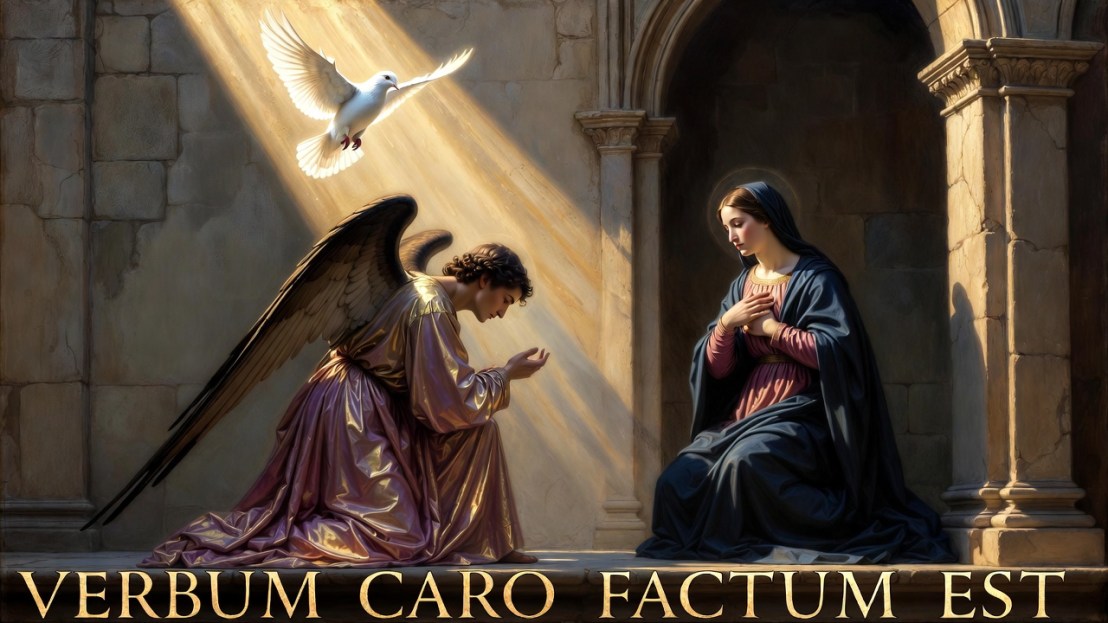
The Greek verb ἐπισκιάσει (episkiasei — “will overshadow”) is a precise theological signal. It is the same verb used in the Septuagint for the glory-cloud of God overshadowing the Tabernacle at its completion (Exodus 40:35 LXX) — the Shekinah, the tangible divine presence dwelling among His people. The angel is not merely announcing a miraculous conception. He is announcing that the new Tabernacle is being consecrated. Mary is the new dwelling place of the living God.
Elizabeth, filled with the Holy Spirit (v.41), addresses Mary as ἡ μήτηρ τοῦ κυρίου μου — “the mother of my Lord.” The word κύριος (Lord) is the standard LXX rendering of the Tetragrammaton, YHWH. Elizabeth is, under direct inspiration of the Holy Spirit, confessing that the child in Mary’s womb is her divine Lord. The Catechism identifies this moment as the very foundation of the title: “Called in the Gospels ‘the mother of Jesus,’ Mary is acclaimed by Elizabeth, at the prompting of the Spirit and even before the birth of her son, as ‘the mother of my Lord.’” (CCC 495)
Mary’s own response to the Annunciation is the Magnificat — not a confession of her own holiness, but a proclamation of what God has done in her through pure grace. “My spirit rejoices in God my Savior” — she acknowledges her own need for the Savior she carries. The Immaculate Conception does not exempt Mary from needing redemption; it means she was redeemed in the most perfect manner, preserved from sin by the merits of her Son applied to her in advance. “From now on all generations will call me blessed” — every generation of Christians has done precisely this, in every language, on every continent, for two thousand years, beginning with Elizabeth under the inspiration of the Holy Spirit.
III. The Ark of the New Covenant: Typology Made Precise
Saint Luke did not write his Gospel in a cultural vacuum. He wrote for readers steeped in the Hebrew Scriptures, readers who knew that certain words, images, and narrative sequences carried enormous theological freight. The Annunciation narrative in Luke 1 is dense with one particular cluster of images: the Ark of the Covenant. The parallels are not decorative. They are doctrinal.
— Catechism of the Catholic Church, §2676. Vatican.va ↗
The Old Covenant Ark and Its Contents
The Ark of the Covenant (Exodus 25:10-22; Hebrews 9:4) was the holiest object in Israel’s worship — a gold-overlaid wooden chest housing three items: the stone tablets of the Law, a golden urn of manna, and Aaron’s rod that budded. Over it the glory-cloud of God (the Shekinah) rested, and from between the cherubim God spoke to Moses. To touch the Ark without proper sanctification was death (2 Samuel 6:6-7). It was the locus of God’s presence among His people in a uniquely concentrated way.
The New Covenant Ark and Her Contents
The Ark of the Old Covenant
The New Covenant Ark — Mary
Biblical Reference
The stone tablets of the Law — the written Word of God
The eternal Word of God made flesh
John 1:1, 14; Gal 4:4
The golden urn of manna — bread from heaven that kept Israel alive
Jesus — the Bread of Life come down from heaven
John 6:35, 48-51
Aaron’s rod that budded — sign of the eternal priesthood
Jesus — the eternal High Priest after the order of Melchizedek
Hebrews 7:24-25
The Shekinah glory-cloud “overshadowed” the Ark (LXX: ἐπισκιάζω)
The Holy Spirit “overshadowed” Mary (ἐπισκιάσει)
Exod 40:35 LXX; Luke 1:35
David asks: “How can the Ark of the LORD come to me?” (2 Sam 6:9)
Elizabeth asks: “How is it that the mother of my Lord should come to me?” (Luke 1:43)
2 Sam 6:9; Luke 1:43
David danced and leaped before the Ark as it entered Jerusalem (2 Sam 6:14)
John the Baptist leaped in the womb as Mary, carrying Jesus, arrived (Luke 1:44)
2 Sam 6:14-16; Luke 1:44
The Ark remained in the hill country of Judah for three months (2 Sam 6:11)
Mary remained in the hill country with Elizabeth for three months (Luke 1:56)
2 Sam 6:11; Luke 1:56
Luke’s Annunciation narrative echoes 2 Samuel 6 with deliberate precision. The parallels are not coincidental — they are typological identification. Mary is presented as the living Ark of the New Covenant.
Saint Ambrose of Milan (c. 339-397) was among the first to draw this out explicitly: “The prophet David danced before the Ark. Now what else should we say the Ark was but holy Mary? The Ark bore within it the tables of the Testament, but Mary bore the Heir of the same Testament itself. The former contained in it the Law, the latter the Gospel. The one had the voice of God, the other His Word.” (cited in the tradition collected by St. Athanasius and others on Mary as Ark, available through the patristic records compiled at NewAdvent.)
The theological force of the Ark typology is not merely decorative. It establishes what kind of presence Mary bore. The Ark was holy because it carried the presence of God. Mary is holy — supremely, uniquely holy — because she carried not merely the symbols of God’s presence but God Himself, in the flesh of her Son. The Immaculate Conception is not an arbitrary privilege. It is the precondition that the logic of the Ark typology requires: the vessel of the divine presence must be worthy of what it contains.
IV. Mary as the New Eve: Irenaeus and the Recapitulation
The oldest systematic Marian theology in the Christian tradition is not devotional but soteriological. It is the New Eve typology, developed with extraordinary precision by Saint Irenaeus of Lyon (c. AD 130-202), approximately 230 years before the Council of Ephesus. For Irenaeus, understanding Mary’s role in salvation requires understanding the structure of God’s plan of recapitulation — the conviction that in Christ, all of human history is gathered up, reversed, and restored through the precise inversion of what Adam and Eve corrupted.
— St. Irenaeus of Lyon, Against Heresies 5.19.1, c. AD 180. ANF 1. NewAdvent ↗
— St. Irenaeus of Lyon, Against Heresies 3.22.4, c. AD 180. ANF 1. NewAdvent ↗
Irenaeus identifies a structural parallelism of extraordinary theological precision:
Eve — The Virgin Who Bound the Knot
A virgin, betrothed but not yet knowing a man
Received the word of an angel (the serpent)
Disobeyed — trusted the lying word
Became the cause of death for herself and the human race
The knot of disobedience was tied
Mary — The Virgin Who Loosed the Knot
A virgin, betrothed but not yet knowing a man
Received the word of an angel (Gabriel)
Obeyed — trusted the true word: “Let it be done to me according to your word”
Became the cause of salvation for herself and the human race
The knot of Eve’s disobedience was loosed
The precision of the parallel is not poetic. It is soteriological architecture. For Irenaeus, God’s plan of recapitulation required that the undoing of the Fall mirror the structure of the Fall itself. Death came through a virgin’s disobedience at the word of an angel; life comes through a virgin’s obedience at the word of an angel. The same God who said “it is not good for man to be alone” in Eden now ensures that the new Adam does not enter the world without a new Eve who corresponds to and reverses the first. The Catechism explicitly quotes Irenaeus at CCC 494: “As St. Irenaeus says, ‘Being obedient she became the cause of salvation for herself and for the whole human race.’ Hence not a few of the early Fathers gladly assert… ‘The knot of Eve’s disobedience was untied by Mary’s obedience: what the virgin Eve bound through her disbelief, Mary loosened by her faith.’”
The Protoevangelium: Genesis 3:15
— Genesis 3:15 (ESV). The Protoevangelium — “the first gospel.”
The Fathers uniformly recognized Genesis 3:15 as the first Messianic prophecy — and the first Marian prophecy. The “woman” whose seed defeats the serpent is both a general reference to humanity and a specific prefigurement of the Virgin Mary, whose Son — uniquely born without a human father, thus the “seed of the woman” in a biological sense unprecedented in Scripture — delivers the decisive blow to the serpent. Isaiah 7:14 confirms the sign: “A virgin shall conceive and bear a son.” The enmity is absolute, the victory complete, and both require the woman as the instrumental human agent of the Incarnation.
V. The Battle of Ephesus: Nestorius, Cyril, and the Definition
In AD 428, Nestorius became Patriarch of Constantinople and quickly made his position known from the pulpit: the title Theotokos was doctrinally dangerous, and he preferred Christotokos — Mother of Christ — as an alternative. What appeared to be a technical terminological debate was in fact a dispute about the unity of Christ’s person. It would explode into the most dramatic conciliar confrontation of the patristic age.
The Error of Nestorianism
Nestorius belonged to the Antiochene theological school, which emphasized the distinction of Christ’s two natures. His formulation, however — influenced by his teacher Theodore of Mopsuestia — went further than legitimate emphasis on distinction. He spoke of “the man assumed” by the Logos and the divine Logos Himself as if they were two subjects joined by moral unity, a common will, and a “conjunction” of persons. On this view, what Mary bore was strictly the human subject — the man Jesus — and to call her “Mother of God” would be to say she gave birth to the divine nature itself, which is metaphysically absurd.
Cyril of Alexandria saw immediately that Nestorius’s position, however carefully qualified, destroyed the unity of Christ. If there are two subjects — the assumed man and the assuming Word — then Christ is not one person but two, and the principle of the communicatio idiomatum (the communication of properties) collapses. We could no longer say “God was born” or “God suffered” or “God died,” since on Nestorian logic those predicates apply only to the human subject, not to the divine. And if God did not really die on the Cross, the death is not of infinite redemptive value. The entire architecture of salvation depends on the unity of the person of Christ.
Cyril’s Letter to Nestorius and the Council of Ephesus (AD 431)
Cyril wrote to Nestorius with pastoral urgency and theological precision, invoking the authority of Pope Celestine I, who had already condemned Nestorius at a Roman council on August 11, 430. When Nestorius refused to recant, Emperor Theodosius II summoned a general council at Ephesus. The city itself was a statement: Ephesus had been the center of Marian devotion since the apostolic age, and the sessions were held in the Church of Mary.
The Council met on June 22, 431. Nestorius was summoned three times and refused to appear. Cyril presided — holding simultaneously the authority of his own Alexandrian see and the commission of Pope Celestine. After reading Cyril’s second letter to Nestorius and examining it against the Nicene Creed, the bishops voted: Cyril’s letter was in conformity with Nicaea; Nestorius’s teaching was not. The sentence was passed unanimously by 197 bishops and subscribed by others later. The definition reads, as recorded in the Acts of the Council:
— Council of Ephesus (AD 431), Letter of Cyril confirmed as conciliar definition. DH 250-252. NewAdvent ↗
The crowds of Ephesus, according to contemporary accounts, gathered outside the church through the night awaiting the result. When the sentence was announced, they lit torches and escorted the bishops through the streets with singing. The city of Ephesus understood — as the theologians debating inside had understood — that something far more than a Marian title had been at stake. The unity of their Savior, and with it the reality of their salvation, had been confirmed.
Pope Sixtus III confirmed the Council’s decisions shortly after his own ordination on July 31, 432. The full authority of the Apostolic See was united with the conciliar definition. Theotokos was not the conclusion of a pious tradition. It was defined dogma of the universal Church.
VI. Chalcedon Confirmed: True God and True Man, Born of Mary
The Council of Chalcedon (AD 451) — the Fourth Ecumenical Council — did not supersede Ephesus. It completed it. Where Ephesus had defined the unity of Christ’s person against Nestorius’s implied separation, Chalcedon defined the integrity of Christ’s two natures against the Monophysites, who in reaction to Nestorius went too far in the other direction and collapsed the human nature into the divine.
— Council of Chalcedon (AD 451), Definition of Faith. DH 301-302. NewAdvent ↗
Chalcedon embedded Theotokos in the very definition of orthodox Christology. To accept Chalcedon — as every orthodox Christian body does — is to accept Theotokos. The title is not a Catholic addition to the creedal tradition. It is constitutive of the creedal tradition, written into the definitive Christological statement of the patristic age by the consensus of East and West, confirmed by Pope Leo I whose Tome to Flavian shaped the Council’s language.
Pope Leo I wrote in his Tome (Epistle 28, AD 449): “Each form does the acts which belong to it in communion with the other; namely, the Word performing what belongs to the Word, and the flesh carrying out what belongs to the flesh.” (NewAdvent ↗) This is the doctrine of the communicatio idiomatum: because there is one person in whom both natures subsist, we can predicate human experiences of the divine Son and divine attributes of the human nature assumed. God was born. God suffered. God died. These are the sentences that Theotokos protects — and that Nestorianism forbids.
VII. Mary, Theosis, and the First Disciple
The Church Fathers understood Theotokos not only as a Christological definition but as the pivot of the entire theology of theosis — the deification of human nature through union with the divine. Athanasius’s formula (On the Incarnation 54.3) — “He became man that we might become God” — depends on the Incarnation being real. And the Incarnation’s reality depends on the Theotokos: if Mary truly bore God incarnate, then divinity has entered human flesh from the inside, sanctifying nature from within, opening the way for human beings to become partakers of the divine nature (2 Peter 1:4).
— CCC 484, citing Colossians 2:9 and Luke 1:34-35. Vatican.va ↗
Mary is the first human being in whom the consequence of the Incarnation — intimate union with the divine — was fully realized. She is not deified in the way the Son is God; she does not share the divine essence ontologically. But she received the grace of union with God in the most radical possible way: she became the dwelling place of the eternal Word, she carried the fullness of deity in her womb, and she was overshadowed by the Holy Spirit in a manner that made her the living Tabernacle of God on earth. She is the first and supreme instance of what the Incarnation makes possible for all humanity.
The Catechism describes her as “the masterwork of the mission of the Son and the Spirit in the fullness of time” (CCC 721). She is not the origin of grace but its first and fullest recipient among human beings. She does not stand beside the Son as a co-redeemer but as the creature most perfectly redeemed, the one in whom the entire logic of the Incarnation — God entering human flesh to deify human nature from within — is most fully embodied.
Mary at Cana and at the Cross: The “Woman” of John
John’s Gospel adds a further dimension to the Marian portrait. In the two scenes where Mary explicitly appears — the Wedding at Cana (John 2:1-12) and the Crucifixion (John 19:25-27) — Jesus addresses her not as “mother” but as “Woman” (γύναι). This is not a diminishment. In the literary theology of John’s Gospel, it is a typological elevation: the woman of John 2 and 19 echoes the woman of Genesis 3:15, the woman whose seed defeats the serpent. At Cana, the first sign that inaugurates Christ’s ministry is performed at her intercession — anticipating all her intercessory ministry to come. At Golgotha, the dying Lord entrusts to her the beloved disciple and through him all disciples: “Woman, behold your son.” And to the disciple: “Behold your mother.” (John 19:26-27.) From that hour, John took her to his own. From that hour, the Church has done the same.
VIII. Lumen Gentium: The Magisterium’s Definitive Modern Treatment
The Second Vatican Council gathered all the threads of biblical, patristic, and dogmatic Marian theology into Chapter VIII of the Dogmatic Constitution on the Church, Lumen Gentium (1964) — titled, significantly: “The Blessed Virgin Mary, Mother of God, in the Mystery of Christ and of the Church.” This chapter is the contemporary Magisterium’s most comprehensive statement on Mary. Its governing principle is precisely the one this article has maintained from the beginning: everything in Mariology follows from and returns to Christology.
— Lumen Gentium §67, Second Vatican Council, 1964. Vatican.va ↗
Lumen Gentium establishes several definitive points for Catholic Marian theology:
1. The Divine Motherhood Is the Foundation of All Marian Doctrine
Lumen Gentium §53: “The Virgin Mary, who at the message of the angel received the Word of God in her heart and in her body and gave Life to the world, is acknowledged and honoured as being truly the Mother of God and Mother of the Redeemer.” Every other Marian title and privilege flows from this single source: she is the Mother of God. The Immaculate Conception prepared her to be worthy of this role. Her perpetual virginity expresses the totality of her consecration to this mission. Her Assumption is the completion of what the Incarnation inaugurated in her body. None of these privileges are independent Marian superlatives. They are all necessary consequences of the one foundational truth: she bore God incarnate.
2. Mary as Model and Mother of the Church
Lumen Gentium §63-64: Mary is the typus Ecclesiae — the type and model of the Church. In her obedience of faith at the Annunciation, her preservation of the Word in her heart, and her bringing forth of the Son into the world, she models what the Church is and does in every generation. The Church receives the Word, conceives new children through Baptism, and brings Christ to birth in the world. Mary’s motherhood is the original of which the Church’s motherhood is the participation.
3. The Balance: Neither Minimizing nor Exaggerating
Lumen Gentium §67 explicitly cautions against two opposite errors: exaggerating Mary’s role in ways that obscure her creatureliness and dependence on Christ, and minimizing her role in ways that deny the genuine significance of her cooperation in salvation history. “Authentic Marian doctrine is ensured by fidelity to Scripture and Tradition, as well as to the liturgical texts and the Magisterium. Its indispensable characteristic is the reference to Christ: everything in Mary derives from Christ and is directed to him.” (Pope John Paul II, General Audience, October 29, 1997. Vatican.va ↗)
4. The Immaculate Conception — Redeemed in the Most Perfect Manner
The Catechism states: “The ‘splendour of an entirely unique holiness’ by which Mary is ‘enriched from the first instant of her conception’ comes wholly from Christ: she is ‘redeemed, in a more exalted fashion, by reason of the merits of her Son.’” (CCC 492, citing Lumen Gentium §53.) This is the precise Catholic position against two common misunderstandings. First, Mary’s sinlessness does not mean she did not need a Savior — she needed one more perfectly than anyone, because the grace that preserved her was the grace of her Son applied to her in advance. Second, her sinlessness is not an elevation to divine status — it is the perfection of creaturely holiness, the creature most fully cooperating with grace. She is maximally human, not minimally so.
The Logic of Theotokos in One Argument
1. The eternal Son of God took His human nature from a human mother (Galatians 4:4 — γενόμενον ἐκ γυναικός).
2. The one who was born of her is not a human subject distinct from the divine Word, but the divine Word Himself (Council of Ephesus, AD 431 — DH 252).
3. Therefore: the woman who bore the divine Word incarnate is rightly called Theotokos — God-bearer, Mother of God.
This is not a pious superlative. It is a logical entailment. Deny it, and you have denied either the real humanity of Christ (Docetism) or the unity of His person (Nestorianism). Both of these have been condemned by the universal Church since the first century.
Sub tuum praesidium confugimus,
Sancta Dei Genitrix.
We fly to your protection, O Holy Mother of God.
The oldest known Marian prayer — Sub Tuum Praesidium — found in a Greek papyrus, c. AD 250–280 (Rylands Papyrus 470, John Rylands Library, Manchester). The Church prayed to the Theotokos more than a century and a half before Ephesus defined the title.


Leave a Reply