Did the Council of Nicaea Invent the Trinity? The Pre-Nicene Evidence
This is Part 6 of a 7-part series: The Holy Trinity — Answering Jehovah’s Witnesses.
Introduction
Among the most common and most effective-sounding objections the Watchtower raises against the Trinity is this: the doctrine was invented at the Council of Nicaea in AD 325 — a political event convened by the Roman Emperor Constantine, at which pagan and corrupt church leaders voted the Trinity into existence by a slim majority. Before Nicaea, on this account, no Christian believed that Jesus was God.
It is a compelling narrative. It sounds like a history lesson. It names dates, places, and a real historical event. And it is almost entirely false.
In this post, we will demonstrate with specific, dated, primary-source quotations that Trinitarian theology — the belief that the Father, Son, and Holy Spirit are one God in three Persons, and that Jesus Christ is fully divine — was the consistent teaching of the Christian church from the very first generation after the Apostles. Nicaea did not invent this doctrine. Nicaea defended it against a new heresy that was trying to change it.
What Nicaea Actually Did
First, let us be clear about what the Council of Nicaea (AD 325) actually was and what it actually did.
Nicaea was convened to respond to the teaching of a Libyan presbyter named Arius, who was teaching that the Son of God was a created being — “there was a time when He was not,” as the Arian slogan put it. Arius taught that the Son was the first and greatest of all God’s creations, but was not eternal, not co-equal with the Father, and not truly God in the full sense.
If this sounds familiar, it is because this is essentially the theology of Jehovah’s Witnesses in the twentieth and twenty-first centuries. The Watchtower is Arianism with a new name.
The council did not invent Trinitarian theology. It condemned Arianism as a departure from what the church had always believed. The bishops at Nicaea were defending the received tradition against a new innovation — Arianism. The historical novelty was not the Trinity; the historical novelty was Arius.
As church historian Philip Schaff noted, the Nicene Creed was not a new composition but a “condensation” of what had already been taught. Athanasius — the great defender of Nicene orthodoxy — consistently argued that Arius was the innovator, not the orthodox party.
The Pre-Nicene Witnesses: A Chain from the Apostles
We now present the primary-source evidence — writers who lived and wrote before Nicaea, many of whom were direct disciples of the Apostles themselves.
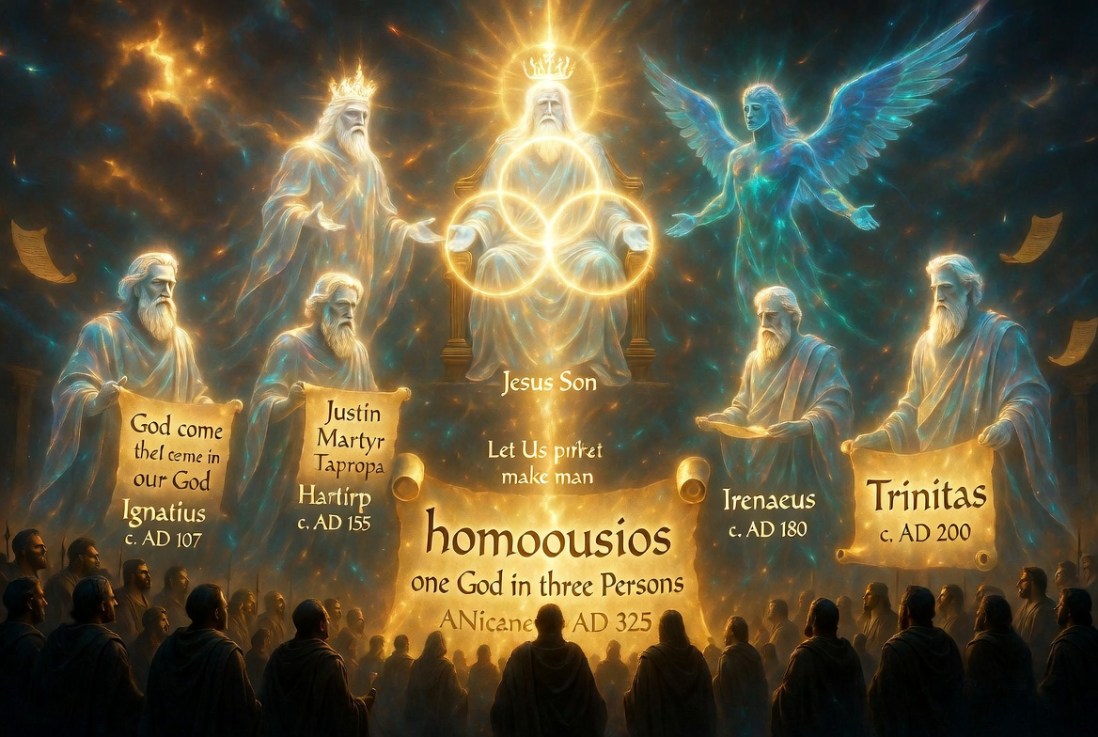
1. Ignatius of Antioch (c. AD 35–107)
Ignatius was bishop of Antioch and, according to ancient tradition, a disciple of the Apostle John himself. He was martyred under the Roman Emperor Trajan — writing his letters to various churches while being escorted to his death in Rome. He wrote at least 110 years before the Council of Nicaea.
In his Letter to the Ephesians (written c. AD 107–110), Ignatius refers to Jesus as “our God” without qualification:
“…there is one physician, both carnal and spiritual, born and unborn, God come in the flesh, true life in death, both from Mary and from God, first subject to suffering and then impassible — Jesus Christ our Lord.” (Eph. 7:2)
And again: “Being as you are imitators of God, once you took on new life through the blood of God.” (Eph. 1:1)
A direct disciple of John the Apostle called Jesus Christ “our God” and “God come in the flesh” — over 200 years before Nicaea. This is apostolic testimony, one generation removed from the source.
2. Justin Martyr (c. AD 100–165)
Justin was a philosopher-turned-Christian apologist who wrote his First Apology around AD 150–155 — 170 years before Nicaea — addressing it to the Roman Emperor Antoninus Pius. He describes Christian baptismal practice:
“There is pronounced over him who chooses to be born again, and has repented of his sins, the name of God the Father and Lord of the universe; he who leads to the laver the person that is to be washed calling him by this name alone. For no one can utter the name of the ineffable God… Also in the name of Jesus Christ, who was crucified under Pontius Pilate, and in the name of the Holy Spirit, who through the prophets foretold all things about Jesus.” (First Apology 61)
Justin also writes of Christ: “…the Father of the universe has a Son; who also, being the first-born Word of God, is even God.” (First Apology 63). Justin affirms that the Son is both “first-born” and “God” — the same combination of terms that modern Trinitarians use.
3. Irenaeus of Lyons (c. AD 130–202)
Irenaeus was a disciple of Polycarp, who was himself a disciple of the Apostle John. He wrote his monumental work Against Heresies around AD 180 — 145 years before Nicaea. His theology is explicitly and robustly Trinitarian:
“He [Jesus Christ] is himself in his own right, beyond all men who ever lived, God, and Lord, and King Eternal, and the Incarnate Word, proclaimed by all the prophets, the apostles, and by the Spirit himself.” (Against Heresies 3.19.2)
“For with him were always present the Word and Wisdom, the Son and the Spirit, by whom and in whom, freely and spontaneously, he made all things, to whom he speaks, saying, ‘Let us make man.’” (Against Heresies 4.20.1)
Irenaeus even uses the plural address of Genesis 1:26 as evidence for the multi-Personal nature of God — and interprets the Son and Spirit as the two “Hands of God” by which the Father works. This is pre-Nicene Trinitarian theology in its full expression.
4. Tertullian (c. AD 155–220)
Tertullian, a North African church father writing around AD 200 — 125 years before Nicaea — was the first Christian writer to use the Latin word trinitas (Trinity) and to set out the doctrine in its classic formulation: one substance (substantia), three Persons (personae). His treatise Against Praxeas is an extended theological defense of the distinction between the three Persons within the one God — written against a theologian who denied the distinction (i.e., taught Modalism).
“We define that there are two, the Father and the Son, and with the Holy Spirit three, according to the rule of sacrament… not that he is three, but that he is three persons… the three are one.” (Against Praxeas 2)
Tertullian did not invent this doctrine. He articulated and defended what the church already believed against those who were trying to modify it.
5. Hippolytus of Rome (c. AD 170–235)
Hippolytus was a disciple of Irenaeus and wrote extensively about the divine nature of Christ and the Trinity. His Refutation of All Heresies and Against Noetus contain explicit statements about the co-divinity of Father, Son, and Spirit:
“The Logos alone of this God is from God himself; wherefore also the Logos is God, being the substance of God… this Logos we know to be the Son of God.” (Against Noetus 10)
6. Origen of Alexandria (c. AD 184–253)
Origen, though some of his speculative ideas were later questioned, clearly affirmed the eternal divinity of the Son and the personal deity of the Holy Spirit — writing almost a century before Nicaea. In his De Principiis he writes that “the Holy Trinity” is to be worshipped, and that the Son is “God of God” — divine from the divine.
The Apostolic Chain: From John to Nicaea
The most powerful argument against the “Nicaea invented the Trinity” claim is the unbroken chain of apostolic tradition:
John the Apostle → Polycarp of Smyrna → Irenaeus of Lyons → Hippolytus of Rome
This chain carries Trinitarian theology directly from an eyewitness of the risen Christ to a theologian writing nearly 100 years before Nicaea. This is not a doctrine invented in 325 AD. This is a doctrine received from the Apostle who laid his head on the breast of Jesus.
What About Constantine?
The Watchtower suggests that Constantine “forced” the Trinity on the council. This is historically inaccurate in multiple ways:
Constantine himself was not baptized until shortly before his death — he was a political patron of the church, not its theological authority
The bishops at Nicaea came from all over the empire, many bearing physical scars from the recent persecution of Christians under Diocletian — they were hardly political pawns of the emperor
The council voted against Arianism with an overwhelming majority — only 2 bishops ultimately refused to sign the creed. This was not a close political vote
Constantine himself initially favored a compromise position and only sided with the Nicene party after the theological arguments were made by the bishops
Athanasius — who attended the council as a young deacon and later became its greatest champion — was exiled five times by emperors for refusing to compromise Nicene orthodoxy. If the Trinity were a political invention of Constantine, why did the most prominent Trinitarian defender spend most of his career fighting Roman emperors who wanted him to compromise it?
Arianism Was the Innovation
The historical evidence points in exactly the opposite direction from the Watchtower’s narrative. It was Arianism — the teaching that the Son is a created being — that was the new, controversial, unprecedented doctrine in the fourth century. It was Arianism that lacked the witness of the pre-Nicene fathers. It was Arianism that required reinterpretation of all the Trinitarian passages in earlier writers.
When Athanasius argued against Arius, his primary appeal was always to the tradition of the church — to the Scriptures as interpreted by the fathers who came before. His opponents could not make the same appeal with anything like the same consistency.
Conclusion
The claim that Nicaea invented the Trinity is not history — it is Watchtower mythology. The historical record shows:
Ignatius (disciple of John, c. AD 107) called Jesus “our God” and “God come in the flesh”
Justin Martyr (c. AD 150) affirmed the Son is “God” and described Trinitarian baptismal practice
Irenaeus (disciple of Polycarp, disciple of John, c. AD 180) taught the full co-divinity of Father, Son, and Spirit
Tertullian (c. AD 200) coined the word “Trinity” and articulated the classic doctrine of three Persons, one substance
Nicaea (AD 325) defended what the church had always believed against the new heresy of Arianism
It was not the Trinity that was invented in the fourth century. It was the doctrine that Jesus is a created being — the very doctrine the Watchtower teaches today — that the church examined, tested against Scripture and tradition, and rejected as heresy.
Key Sources Referenced: Ignatius of Antioch, Letter to the Ephesians (c. AD 107) | Justin Martyr, First Apology (c. AD 155) | Irenaeus, Against Heresies (c. AD 180) | Tertullian, Against Praxeas (c. AD 200) | Hippolytus, Against Noetus (c. AD 200) | Athanasius, On the Incarnation | Nicene Creed (AD 325)


Leave a Reply