The “smallest of all seeds” objection has circulated for centuries. Examined honestly — in Greek, in the soil of Galilee, and in the text itself — it does not stand.
The Short Answer
Jesus was not making a global botanical claim about every seed on earth. Within the world He was describing — the seeds first-century Palestinian farmers actually sowed in their fields and gardens — the mustard seed was the smallest, and it grew into one of the largest of the garden plants. No one has produced a cultivated seed of that time and place that was both smaller than the mustard and grew into a larger plant. The objection mistakes a proverb for a science lesson.
It is one of the most repeated charges against the Gospels. In Saint Mark’s account, our Lord says the mustard seed is “less than all the seeds that are upon the earth.” The skeptic answers: but it is not. Orchid seeds are far smaller; so are several others. Therefore — the argument runs — Jesus erred, the Gospel contains a falsehood, and its authority is undone.
The charge is old, confident, and mistaken. It mistakes the kind of statement Jesus was making. And once we read the passage on its own terms — the terms set by the Greek words, by the agriculture of His hearers, and by the prophetic tradition He was drawing upon — the objection quietly dissolves. What remains is a parable of startling depth about the Kingdom of God.
Let us take the objection in its strongest form, and answer it completely.
I – The Objection, Stated Fairly
The relevant words are these:
“It is like a grain of mustard seed, which, when it is sown in the earth, is less than all the seeds that are in the earth. And when it is sown, it groweth up, and becometh greater than all herbs, and shooteth out great branches, so that the birds of the air may dwell under the shadow thereof.”
Mark 4:31–32, Douay–Rheims
The objector presses on the phrase “less than all the seeds.” Modern botany, he observes, knows of many smaller seeds — the dust-like seeds of orchids above all. If “smallest of all seeds” is read as a statement of universal botanical fact, it is simply false. We will grant the botany at once: the mustard seed is not the smallest seed in the world. The question is whether the parable was ever making that claim.
II – What the Text Actually Says
Read the sentence again and notice the verbs. The seed is sown. It is sown in a field or garden. It is sown by a farmer. This is not a survey of all botanical life; it is a picture of cultivation. And the three Synoptic accounts are unanimous on this frame: Saint Mark says the seed is sown “in the earth” (Mark 4:31); Saint Matthew, that “a man took and sowed in his field” (Matthew 13:31); Saint Luke, that “a man took and cast into his garden” (Luke 13:19).
The comparison, in other words, is bounded from the start. It concerns the seeds a sower handles, the seeds of the cultivated field and garden. Whether some wild plant in a distant marsh produces a smaller seed is simply not in view. The parable speaks of farming, and within farming its claim is exact.
III – The Greek Settles the Category: Lachanon
The decisive evidence is in the very next line. Jesus does not say the mustard becomes greater than all plants or all trees. He says it becomes greater than all the λáχανα (lachana) — in Mark 4:32 and Matthew 13:32 alike.
The word lachanon (Strong’s Greek 3001) means a garden herb, a vegetable, a cultivated garden plant. Thayer’s lexicon defines it precisely as “garden-herbs, as opposed to wild plants.” That definition is doing real work. The word Jesus chose to name the comparison-class is the word for cultivated plants, set deliberately over against the wild.
The word He chose draws the boundary for us: garden plants, not the whole botanical world.
This carries the most popular objection away before it begins. Wild orchids are not lachana. Neither are wild poppies. The text is not comparing the mustard seed to every seed in creation; it is comparing it within the world of the sown garden — and there the statement holds.
IV – A Proverb, Not a Botany Lesson
There is a second key, and it lies in how the people of that time actually spoke. In Jewish usage the mustard seed was the standard byword for the smallest perceptible thing — a proverbial measure, not a laboratory verdict. The Mishnah preserves the idiom and, tellingly, qualifies it: a quantity may be “like the size of a mustard seed, or even smaller than that” (Mishnah, Niddah 5:2).
That qualification is decisive. The rabbis used “mustard seed” to mean “something tiny” while freely admitting that smaller things existed. The phrase was idiom, not taxonomy. When Jesus, speaking as a teacher within that very culture, used the same proverbial measure, He was speaking as His hearers spoke — and they understood Him perfectly. To demand that this idiom answer to a botanist’s seed-bank is to read it in a way no first-century listener ever would.
V – The Witness of Scholarship
This is not a modern apologetic invention. Conservative scholarship has long made exactly this point. Gleason Archer, in his work on Bible difficulties, argued that the mustard seed was the smallest seed the Palestinian farmer was accustomed to sow — the smallest in his agricultural experience, which is the only frame the parable assumes. The nineteenth-century commentator J. W. McGarvey made the same observation: the saying reflects the everyday practice of the sower, not a universal botanical register.
And the other half of the parable is equally well attested. The black mustard of the region (Brassica nigra) grows, under favorable conditions, into a tall shrub — commonly cited at roughly eight to ten feet — sturdy enough for birds to perch and shelter in its branches. The contrast at the heart of the parable is real: a proverbially tiny seed yielding a strikingly large plant.
VI – Answering the Orchid
The orchid is the objector’s favorite, so let us meet it directly. It fails on three independent grounds.
First, orchid seeds cannot simply be sown and grown. The Royal Botanic Gardens, Kew, confirm that orchid seeds are dust-like and lack the nutritive endosperm other seeds carry; in nature they depend on a partnership with mycorrhizal fungi in the soil to germinate at all. They are not seeds a farmer takes in his hand and casts into a furrow.
Second, orchids were not cultivated field or garden crops in first-century Palestine. Whatever orchids grew in the region grew wild. They fall entirely outside the parable’s frame of a farmer sowing his field — and outside the meaning of lachanon.
Third, the native orchids of the land do not become large plants. The Flora of Israel records species such as Ophrys holosericea as upright plants of some thirty to sixty centimetres — far below the towering mustard shrub. Even granting a smaller seed, the orchid satisfies neither the cultivation nor the great-plant side of the comparison. It is not a counter-example; it is a different category of plant entirely.
VII – Answering the Poppy
The poppy is the more careful objection, because the poppy seed genuinely is smaller than the mustard seed. Here the answer is not lexical but structural. Grant that poppy seeds are smaller — the parable is undisturbed, because the poppy does not become the large, branching shrub the parable describes. It remains a modest herbaceous plant. A counter-example would have to satisfy both halves of the comparison: a smaller cultivated seed that nonetheless grows into a larger branching plant than the mustard. The poppy proves only that smaller seeds exist — which no one denies and which the parable never contradicts.
Smaller seeds exist. None of them is a counter-example.
VIII – The Fig, and the Rest
What of figs, or any of the other “smaller seeds” sometimes produced? The same test answers them. Fig trees, in ordinary cultivation, are not raised from individual seeds cast into a field; fig cultivation proceeds by cuttings and saplings. The parable’s premise — a farmer who takes a seed and sows it and watches it become a great plant — simply does not describe how such plants were grown. Every proposed counter-example must clear the same four-part bar: was it a seed sown in field or garden cultivation; was it smaller than mustard; did it grow into a larger plant; and did that plant put out branches able to shelter birds? No first-century Palestinian cultivated seed has ever been shown to clear all four. That, and not a botanist’s catalogue, is the test the parable sets.
IX – Birds in the Branches: The Key the Skeptic Misses
Here we reach the heart of the matter, and the reason the whole objection is misconceived. The closing image — “the birds of the air may dwell under the shadow thereof” — is not a botanical observation at all. It is one of the most recognizable images in Hebrew prophecy: the great tree in whose branches the birds nest, standing for a kingdom that shelters the nations.
Ezekiel sees the Lord plant a tender shoot that becomes a noble cedar, “and every small bird will nest under it” — an image the tradition reads as the restoration of the house of David (Ezekiel 17:22–23). The same prophet describes a towering tree in whose boughs “all the birds of the sky nested” and in whose shade “all the mighty nations dwelt” (Ezekiel 31:6). Daniel sees a great tree whose branches house the birds of the air, signifying a vast dominion (Daniel 4). The motif is fixed: a great tree, birds in its branches, shelter for the peoples — a kingdom.
This is not a stray parallel. The Catholic study notes of the New American Bible link the mustard parable’s birds directly to this Old Testament tree-and-kingdom imagery. Jesus is reaching for a stock prophetic picture and filling it with new meaning.
Jesus was not running a botany exam. He was unveiling a kingdom.
X – The Meaning of the Parable
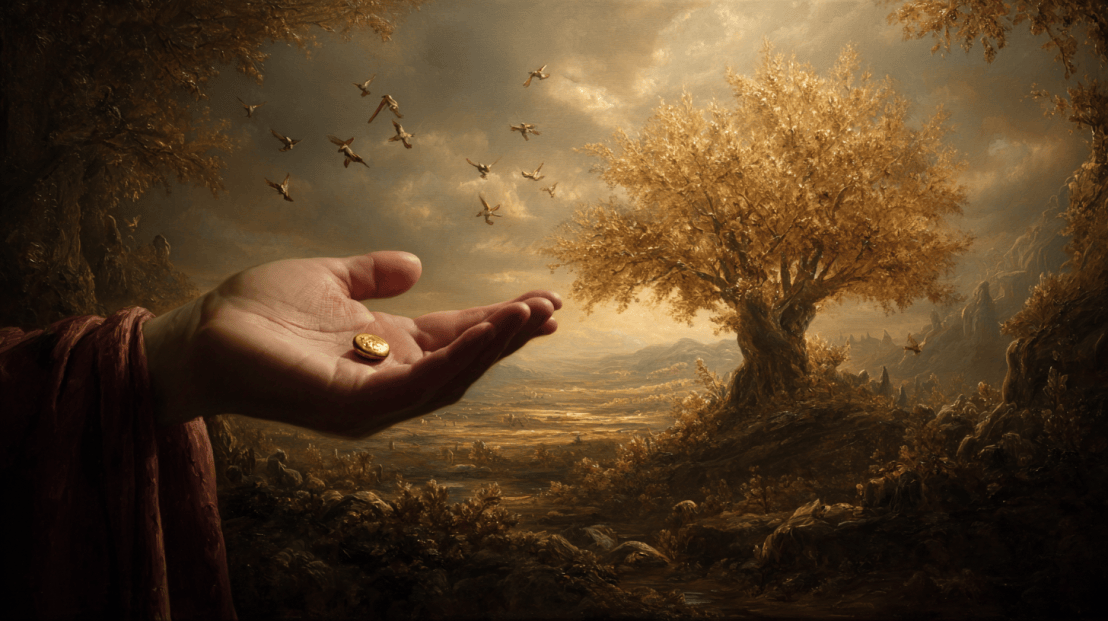
Now the parable opens. Christ takes the smallest thing in His hearers’ daily experience — the proverbial mustard seed — and the largest sheltering tree of prophetic vision, and joins them. The Kingdom of God, He says, is like that: it begins almost invisibly, in a manger, in a handful of fishermen, in a seed pressed into the dark earth; and it grows, against every expectation, into the great tree in whose branches the nations of the world find shelter and rest.
To read this as a failed botany lecture is to miss it entirely — rather like faulting a love poem for bad astronomy because it calls the beloved’s eyes two stars. The genre is parable. The subject is the reign of God. And the “error” the skeptic thinks he has found turns out to be the very hinge of the meaning: from the least of all beginnings, the greatest of all kingdoms.
XI – An Unexpected Witness
One further point deserves mention, for it shows how deeply this Gospel imagery is woven into the wider religious memory of the world. The Qur’an, describing the followers of its prophet, reaches for precisely this picture and attributes it expressly to the Gospel: their likeness “in the Gospel” is “like a seed” that puts forth its shoot, strengthens, thickens, and stands firm upon its stem, delighting the sowers (Qur’an 48:29).
The classical commentator Maududi, explaining this verse, quotes the Gospel passage in full to identify the parallel — reproducing the parable of the growing seed and, with it, the mustard-seed parable itself, including the very words “less than all the seeds that are in the earth” and “the fowls of the air may lodge under the shadow of it.” The point is simply this: the seed-and-shelter imagery of Mark 4 is so plainly meaningful that it is invoked even outside the Christian tradition to describe a community’s growth. The image the skeptic dismisses as a botanical blunder is, across traditions, recognized for what it is — a profound figure of a kingdom that grows from nothing into a shelter for the nations.
XII – The Verdict
Set the pieces together and the objection has nowhere to stand. Jesus spoke as a Jewish teacher, using a familiar agricultural proverb. The Synoptics frame the seed as sown in field and garden. The Greek itself names the comparison-class as the cultivated garden plants. The mustard seed was proverbially the smallest seed of that world, and it grew into a strikingly large shrub. Smaller seeds exist — the parable never denied it — but no cultivated first-century Palestinian seed has been shown to be both smaller than mustard and to grow into a larger, branching plant. And the birds in the branches were never botany in the first place; they were the ancient sign of a sheltering kingdom.
The most precise way to state the matter is this: within the seeds customarily sown by first-century Palestinian farmers, the mustard seed was the smallest, yet it grew into the greatest of the garden plants — a living parable of the Kingdom of Heaven, which from the humblest of beginnings becomes the tree that shelters the world.
Far from exposing an error, the mustard seed reveals the mind of Christ: that God delights to begin with the small, the hidden, the overlooked, and to bring forth from it something vast and sheltering and full of life. The skeptic came looking for a mistake. He found, instead, the Gospel.
Frequently Asked Questions
Is the mustard seed the smallest seed in the world?
No — and the parable never claims that. In absolute terms the smallest seeds belong to certain orchids, which are dust-like. Jesus’ comparison is set within first-century Palestinian agriculture: among the seeds a farmer customarily sowed in a field or garden, the mustard seed was the smallest.
Did Jesus make a scientific mistake in Mark 4:31?
No. The parable is a proverbial, agricultural comparison, not a modern taxonomic claim. The Greek text itself — using lachanon, “garden plants” — fixes the category as cultivated plants, and the saying belongs to a well-attested Jewish idiom in which the mustard seed stood for the smallest measure.
What does the Greek word lachanon mean?
In Mark 4:32 and Matthew 13:32 the plant the mustard surpasses is the lachanon, a garden herb or vegetable. Standard lexicons define it as “garden-herbs, as opposed to wild plants,” which sets the comparison among cultivated plants — not the whole of global botany.
Aren’t orchid and poppy seeds smaller than the mustard seed?
Yes, but neither overturns the parable. Orchids are wild plants, were not sown as field or garden crops, and do not grow into a large branching shrub. Poppy seeds are smaller, but the poppy does not become the large, branching plant the parable describes. Neither is a counter-example within the parable’s own terms.
What is the parable of the mustard seed actually about?
It is about the Kingdom of God, which begins almost invisibly and grows into a great sheltering reality. The image of birds nesting in the branches is drawn from Old Testament kingdom imagery in Ezekiel and Daniel, where a great tree shelters the nations.
Sources & Further Reading
Scripture: Mark 4:30–32; Matthew 13:31–32; Luke 13:18–19; Ezekiel 17:22–23; Ezekiel 31:6; Daniel 4.
Greek lexicon: lachanon, Strong’s Greek 3001 (Thayer; Mounce) — “garden-herbs, as opposed to wild plants.”
Rabbinic usage: Mishnah, Niddah 5:2 (“like a mustard seed, or even smaller than that”).
Botany: Royal Botanic Gardens, Kew, on orchid seeds; Flora of Israel on Ophrys holosericea and Brassica nigra; Michael Zohary, Plants of the Bible (Cambridge University Press, 1982).
Scholarship: Gleason L. Archer, Encyclopedia of Bible Difficulties; J. W. McGarvey, commentary on the Gospels.
Qur’an 48:29 and Maududi, Tafhim al-Qur’an, commentary on the verse.


Leave a Reply